 how-to
How to Integrate Smart Appliances in Luxury Kitchen Designs
Table of Contents
- Understanding Smart Appliances in Luxury Kitchen Design
- Planning Your Connected Kitchen Technology Layout
- Selecting Luxury Kitchen Appliances That Work Together
- Designing Custom Cabinets for Luxury Appliances
- Smart Kitchen Design Ideas for Seamless Integration
- Managing Electrical, Connectivity, and Installation Requirements
- Budgeting and Long-Term Ownership Considerations
- Frequently Asked Questions
Last Updated: October 5, 2026
Understanding Smart Appliances in Luxury Kitchen Design
Understanding how to integrate smart appliances in luxury kitchen designs reveals they represent far more than gadgets that respond to voice commands. They're the foundation of a connected ecosystem that eliminates friction from your daily routines while maintaining the visual elegance that defines a luxury kitchen.
Integrated smart appliances transform kitchens from beautiful spaces into genuinely functional ones. A smart refrigerator that tracks inventory, a connected oven you control from your phone, and a dishwasher that optimizes water usage don't just work harder, they work together. That's the real power of integration.
The key difference between a smart appliance and a truly integrated one comes down to connectivity. A refrigerator with a touchscreen is smart. A refrigerator that communicates with your grocery app, your oven, and your home's energy management system is integrated. When appliances talk to each other, they create workflows that anticipate your needs rather than just respond to commands.
Planning Your Connected Kitchen Technology Layout
Before you select a single appliance, you need to understand how connectivity flows through your kitchen. This is where most renovations stumble. Homeowners pick appliances first, then discover their Wi-Fi won't reach the far corner where the new refrigerator sits, or the smart oven requires a dedicated circuit that wasn't in the budget.
Start by mapping your kitchen's connectivity zones. Where is your router? How far does your Wi-Fi signal actually reach? Modern smart kitchens need reliable connectivity everywhere, not just in the dining area. If your current network won't support multiple connected devices pulling data simultaneously, upgrading your mesh Wi-Fi system becomes a project prerequisite, not an afterthought.
Next, identify your work zones. A luxury kitchen typically organizes around three areas: prep, cooking, and cleanup. Smart appliances should enhance these zones, not complicate them. Your prep zone benefits from smart storage and inventory tracking. Your cooking zone needs seamless integration between cooktop, oven, and ventilation. Your cleanup zone requires the dishwasher and sink to coordinate efficiently.
Consider traffic patterns. Where do people naturally move? Smart appliances positioned against the flow of your kitchen's actual use create frustration, not luxury. The most elegant integration feels invisible because it anticipates how you actually cook, not how designers think you should cook.
Selecting Luxury Kitchen Appliances That Work Together
The appliances you choose determine whether your kitchen functions as an integrated ecosystem or a collection of independent devices. This is where the difference between luxury and merely expensive becomes clear.
Start with your anchor appliance, typically the refrigerator. This is the device your family interacts with most frequently and the one that benefits most from smart features. A luxury refrigerator with inventory tracking, temperature zones, and Wi-Fi connectivity becomes the hub that other appliances reference. Choose a brand with a strong ecosystem.
Your cooking appliances, range, cooktop, oven, and range hood, should come from the same manufacturer or certified compatible partners. A smart oven that communicates with a range hood from a different ecosystem won't automatically adjust ventilation when you preheat. A connected cooktop that doesn't talk to your oven means you're managing two separate devices instead of one integrated cooking environment.
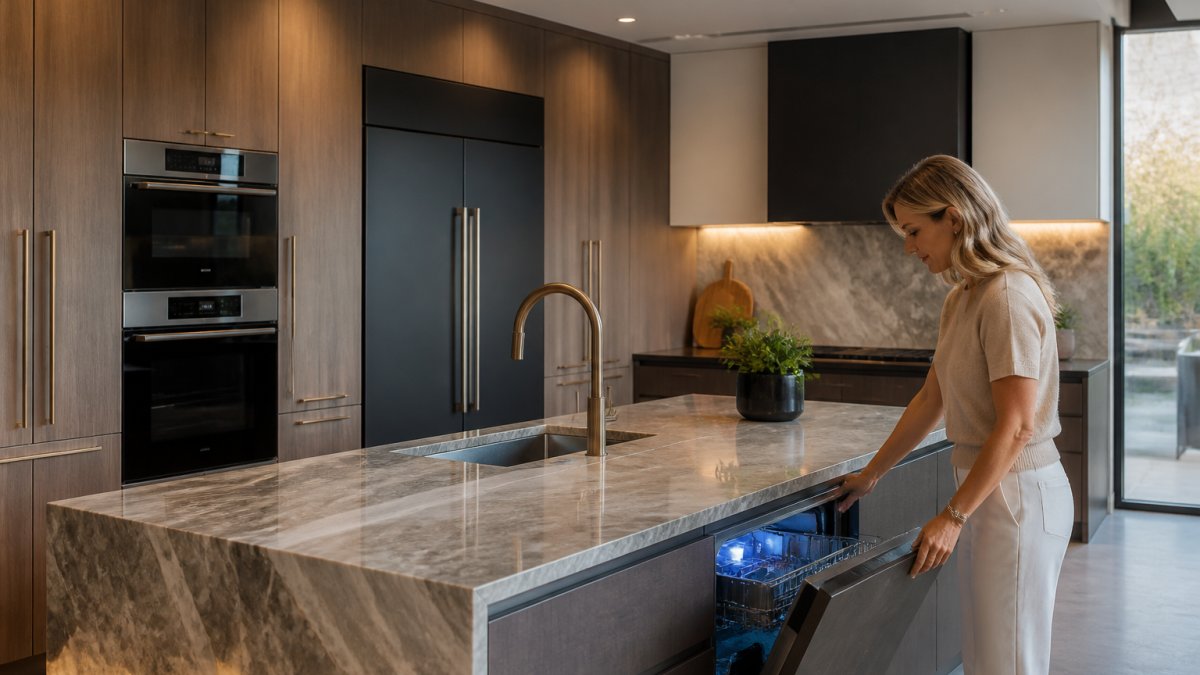
The dishwasher is where convenience becomes tangible. Smart dishwashers that detect soil levels, optimize water temperature, and communicate with your home's energy management system reduce waste while improving results. But they only deliver this benefit if they're integrated with your home's connected system and positioned where they can receive and send data reliably.
Don't overlook secondary appliances. A smart beverage cooler, connected wine fridge, or intelligent pantry system transforms storage from static cabinetry into an active part of your kitchen's intelligence. These devices track what you have, alert you when supplies run low, and integrate with your shopping apps.
Designing Custom Cabinets for Luxury Appliances
Custom cabinetry isn't optional when integrating smart appliances, it's essential. Off-the-shelf cabinet solutions force appliances to fit the design. Custom cabinetry lets the design serve the appliances and the workflow they enable.
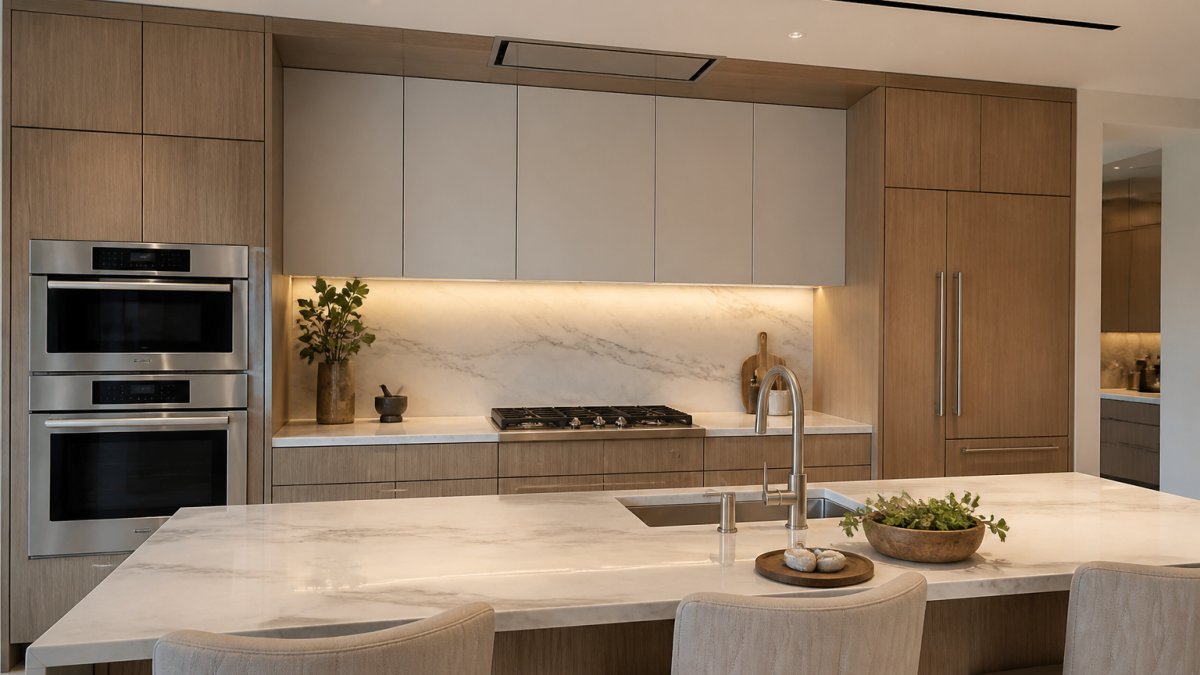
The first decision is concealment versus display. A concealed appliance approach uses cabinet panels that match your cabinetry, making the refrigerator, dishwasher, and oven visually disappear into the design. This creates the seamless, unified aesthetic that defines luxury kitchens.
Display-focused design celebrates the appliance as a design element. A statement refrigerator with a glass door, a professional-grade range with exposed controls, or a sleek induction cooktop becomes part of the visual composition. This approach works when the appliance's design language matches your kitchen's overall aesthetic.
Electrical integration is where custom cabinetry meets technical reality. Smart appliances need dedicated circuits, often positioned differently than traditional appliances. Your cabinetry must accommodate these requirements without visible conduit or awkward wire management. This means coordinating electrical planning with your cabinet design before construction begins.
Connectivity infrastructure goes inside the cabinetry. Ethernet runs, Wi-Fi extenders, and power management systems need homes. Custom cabinetry can hide these systems entirely, creating the clean aesthetic luxury kitchens demand while ensuring reliable connectivity.
Ventilation integration is critical. A luxury kitchen's range hood should be nearly invisible, integrated into the ceiling or a soffit. Smart hoods that communicate with your cooktop and oven require specific installation approaches. Custom cabinetry and ceiling treatments work together to achieve this integration.
Smart Kitchen Design Ideas for Seamless Integration
Learning how to integrate smart appliances in luxury kitchen designs means the most elegant smart kitchens don't feel high-tech. They feel effortless. This requires thinking beyond individual appliances to the overall design philosophy.
Create appliance zones with unified aesthetics. Group your cooking appliances, range, oven, cooktop, hood, in one visual area. Position refrigeration separately. This spatial organization makes the kitchen's logic clear and prevents the scattered, fragmented look that happens when smart appliances are distributed randomly.
Integrate lighting with appliance intelligence. Smart under-cabinet lighting that brightens when you approach the prep zone, task lighting that activates above the cooktop, and ambient lighting that adjusts throughout the day create an environment where technology enhances usability without drawing attention to itself.
Use touchscreen controls and displays strategically. A single command center, a smart display mounted at eye level near your prep zone, can control multiple appliances without cluttering your kitchen with individual screens. This reduces visual noise while improving functionality.
Consider voice control placement. Smart speakers positioned in corners or integrated into cabinetry provide voice control without dominating the visual space. Multiple devices throughout the kitchen ensure you can issue commands from anywhere without shouting.
Appliance garages solve the small-appliance clutter problem. A motorized cabinet door or sliding panel conceals your coffee maker, toaster, and blender while keeping them powered and ready. This design choice became standard in luxury kitchens because it delivers real functionality, not just aesthetics.
Managing Electrical, Connectivity, and Installation Requirements
This is where luxury kitchen integration meets practical reality. Every smart appliance adds electrical load, connectivity demands, and installation complexity. Getting this right determines whether your kitchen functions flawlessly or becomes a source of frustration.
Electrical requirements are non-negotiable. Smart appliances typically need dedicated circuits, a 240-volt circuit for the range, separate 20-amp circuits for the refrigerator and dishwasher, and additional circuits for smaller connected devices. Your electrical panel may need upgrading to support this load.
Calculate your total electrical demand before finalizing appliance selections. A luxury kitchen running multiple smart appliances simultaneously pulls significant power. Many homes require a service upgrade from 100 amps to 200 amps to support a fully integrated smart kitchen.
Ventilation systems for smart kitchens require specialized planning. A connected range hood needs makeup air systems in some climates, dedicated electrical circuits, and ductwork designed for efficient airflow.
Connectivity infrastructure is equally critical. Your home's Wi-Fi network must reliably reach every connected appliance. For kitchens with Wi-Fi dead zones, mesh Wi-Fi systems or dedicated access points become necessary.
Smart appliances often require dedicated networks or specific router configurations. Some manufacturers recommend isolating smart home devices on a separate network from computers and phones. This requires router capabilities many standard systems lack.
Installation coordination matters enormously. Electrical, plumbing, HVAC, and appliance installation must happen in the correct sequence. One mistake, like running electrical before cabinetry is in place, creates expensive rework.
Budgeting and Long-Term Ownership Considerations
Smart appliances cost more than conventional ones. Understanding where that premium goes helps you make informed decisions about where to invest and where to prioritize value.
The premium for smart features typically ranges from 15 to 40 percent above comparable conventional appliances, depending on the manufacturer and features. A smart refrigerator costs more than a conventional one.
Prioritize smart features on appliances you use most frequently. Your refrigerator, which your family accesses multiple times daily, deserves smart connectivity and advanced features.
Energy efficiency gains from smart appliances can offset their higher purchase price over time. A smart refrigerator that optimizes compressor cycles uses less electricity than a conventional model.
Maintenance and support costs require planning. Smart appliances have more complex electronics than conventional ones. When something fails, repair costs are higher and repair times longer because technicians need specialized training.
Software support and ecosystem longevity matter more than most homeowners realize. A smart appliance is only as valuable as the ecosystem supporting it.
Consider compatibility evolution. Technology changes. The Wi-Fi standard your smart kitchen uses today may be obsolete in five years.
Integrating smart appliances into luxury kitchen designs requires thoughtful planning, strategic appliance selection, and professional execution.
Dimensions Luxury Builders brings end-to-end project management expertise to smart kitchen integration.
Get a free quote from Dimensions Luxury Builders and discover how smart appliance integration can transform your kitchen into a space that's as functional as it is beautiful.
Frequently Asked Questions
Can you mix different brands of smart appliances in one kitchen?
Yes, but compatibility depends on the connectivity standard each brand uses. Many luxury appliances connect via Wi-Fi, allowing independent control through separate apps. However, for true integrated control through a single smart home hub, look for appliances supporting common standards like Matter or compatible ecosystems. Before purchasing, verify that your chosen brands can communicate with your smart home system. Mixing brands works well when each appliance has strong individual performance, prioritize quality over forced ecosystem matching.
What electrical upgrades are needed for smart appliances in a luxury kitchen?
Most smart appliances require standard 120-volt or 240-volt circuits depending on the appliance type. High-demand devices like smart ranges, ovens, and refrigerators typically need dedicated circuits to prevent overloads. Your electrician should assess your current panel capacity and run separate circuits for major appliances. Additionally, ensure robust Wi-Fi coverage throughout the kitchen with a mesh network or dedicated router placement. Building permits may be required for electrical work, so coordinate with your contractor before starting installation.
How do you hide smart appliances in a luxury kitchen design?
Custom cabinetry is the primary method for concealing smart appliances while maintaining functionality. Panel-ready refrigerators and dishwashers integrate flush with cabinet fronts, creating a seamless look. Built-in ovens, cooktops, and range hoods can be recessed into cabinetry or surrounded by matching materials. Appliance garages with motorized doors hide countertop devices like coffee makers. Digital displays and touchscreen controls can be positioned at eye level within cabinet faces. Work with your designer to plan appliance placement before ordering cabinets to ensure proper sizing and electrical access.
What's the typical timeline for integrating smart appliances into a luxury kitchen renovation?
The timeline varies based on project scope and custom elements. Custom cabinet fabrication typically takes 6-10 weeks, while appliance lead times range from 4-12 weeks depending on brand and availability. Electrical upgrades and installation usually take 2-4 weeks. Overall, expect 4-6 months from design approval to completion for a full smart kitchen integration. Ordering appliances early and coordinating with your contractor prevents delays. As a local Broward County specialist, Dimensions Luxury Builders manages these timelines to keep your project on schedule.