 comparison
Is High-End Kitchen Lighting Worth the Cost?
Table of Contents
- Is High-End Kitchen Lighting Worth the Cost? The Verdict First
- High-End vs. Standard Kitchen Lighting: Cost and Specs Compared
- Best Practices for Kitchen Task Lighting
- LED Under Cabinet Lighting Lifespan: What You Actually Get
- The Impact of Lighting on Kitchen Resale Value
- Energy Efficiency and Electricity Savings
- Smart Home Integration and Kelvin: Where Most Buyers Miss Value
- Installation Cost, TCO, and ROI: DIY vs. Professional
- Frequently Asked Questions
Last Updated: October 2, 2026
Is High-End Kitchen Lighting Worth the Cost? The Verdict First
Yes, for most homeowners planning a serious kitchen renovation, high-end kitchen lighting is worth the cost. It changes how the room functions, how it photographs, and how buyers respond to it.
Below, we'll break down the real costs, the specs that matter, and where the money genuinely returns value. Here's what most guides get wrong: they treat lighting as a finishing touch instead of a system planned with the cabinetry.
High-End vs. Standard Kitchen Lighting: Cost and Specs Compared
The practical difference between high-end and standard fixtures comes down to four things: color rendering, dimming quality, build materials, and lifespan.
A standard fixture dims in steps, buzzes at low output, and renders colors with a green or blue cast.
| Feature | Standard Fixtures | High-End Fixtures |
|---|---|---|
| Color rendering | Lower CRI, visible color shift | High CRI, accurate food color |
| Dimming | Stepped, may buzz | Smooth, flicker-free |
| Build | Plastic housing | Aluminum profiles, heat sinks |
| Lifespan | Shorter service life | Built for long-term use |
| Control | Basic on/off | Layered, zone-based control |
None of these are about looking fancier. Every one is about how the kitchen works at 7 p.m. on a Tuesday.
Best Practices for Kitchen Task Lighting
The best kitchen task lighting eliminates shadows on your work surfaces rather than making the room brighter overall. Under-cabinet lighting should sit toward the front edge of the cabinet, washing the countertop.
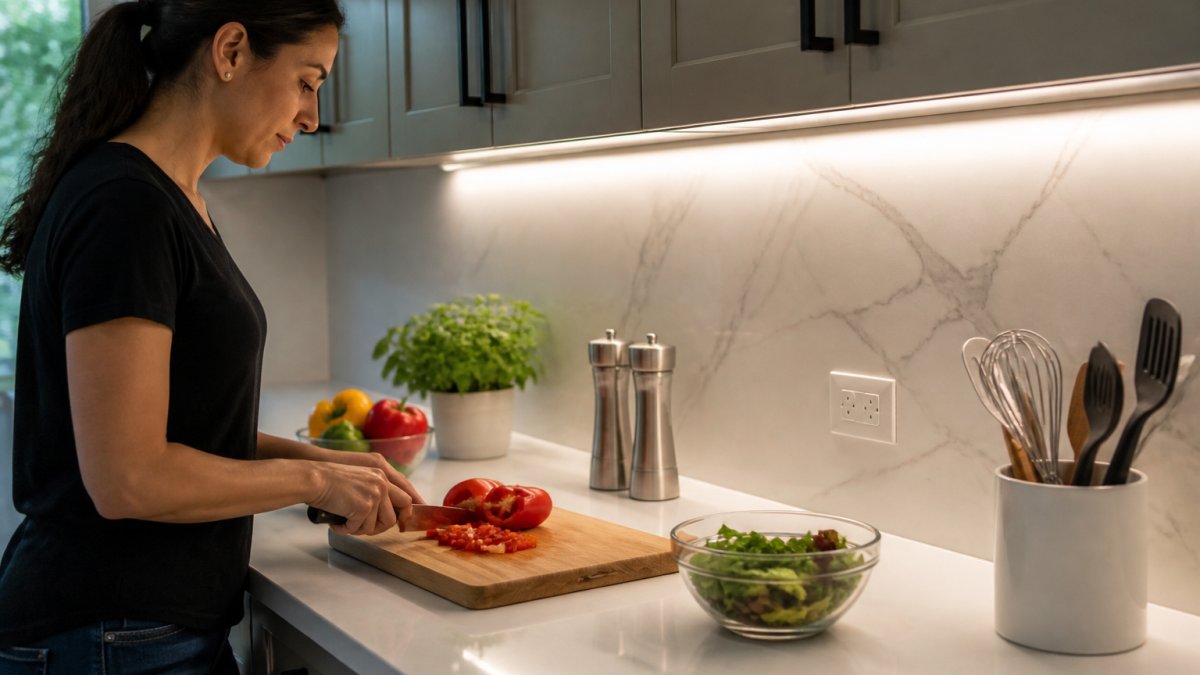
A few rules that hold up in practice:
- Mount under-cabinet fixtures toward the front of the cabinet, not flush against the wall.
- Keep the countertop as the target, so light lands where your hands work.
- Add a dedicated task fixture over the sink, where ambient light rarely reaches.
- Use dimmable controls on every zone, so the same fixture handles prep and dinner.
Layering Ambient, Task, and Accent Light
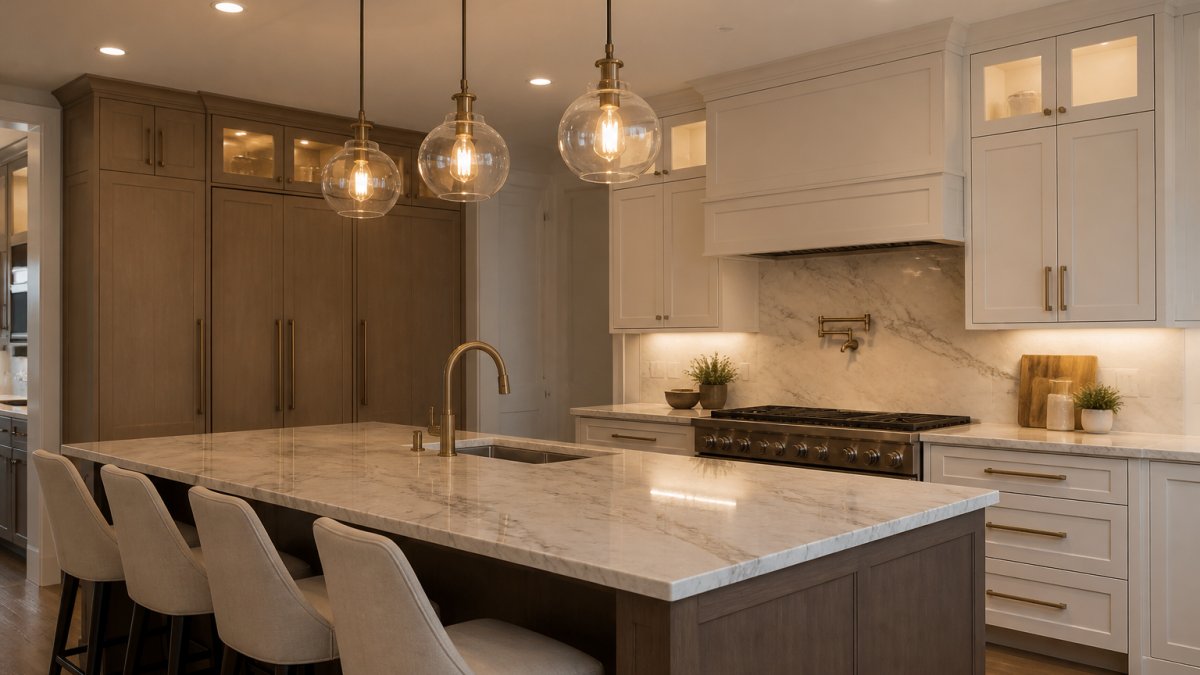
Layered lighting uses three separate light roles in one room: ambient for general brightness, task for work surfaces, and accent for depth and drama. Most kitchens get one layer and call it done, that's why they feel flat.
Ambient light comes from ceiling fixtures or recessed cans. Task lighting handles countertops and sink. Accent lighting, often inside or above glass cabinets, adds the interest that makes a kitchen feel designed rather than lit.
Why Color Temperature and CRI Decide the Result
Color temperature and CRI determine whether your kitchen looks warm and appetizing or cold and clinical. Color temperature is measured in Kelvin; CRI measures how accurately a light renders color compared to natural light.
Most designers land between 2700K and 3500K, warm white to soft neutral, which flatters wood, stone, and food. Cool white above 4000K reads as clinical at home.
LED Under Cabinet Lighting Lifespan: What You Actually Get
LED under cabinet lighting lifespan is typically measured in tens of thousands of rated hours, though real-world life depends heavily on heat management and driver quality.
Heat is the enemy. LEDs fade rather than fail outright, so a poorly ventilated strip loses brightness over years. Aluminum profiles act as heat sinks, which is why architectural-grade systems outlast cheap adhesive strips.
The fixture is rarely the weak link. The power supply and installation quality are.
The Impact of Lighting on Kitchen Resale Value
The impact of lighting on kitchen resale value is real but indirect. Buyers rarely itemize lighting in an offer, they react to the room. A well-lit kitchen reads as larger, cleaner, and more current, and that impression supports the price.
Kitchen remodels remain one of the more reliable renovations for recouping value at resale, according to remodeling industry cost-versus-value research, though the exact return varies by market and finish level. Lighting is a small line item inside that larger number.
Where lighting helps most is photography. Listing photos are often taken with limited natural light, and a kitchen with layered, warm, high-CRI lighting photographs dramatically better than one with a single overhead fixture.
Energy Efficiency and Electricity Savings
Energy efficiency is where LED lighting earns its keep, but the size of the win depends on what you're replacing and how long the lights run.
A typical halogen under-cabinet puck draws roughly 20 watts; a comparable LED puck draws 3 to 4 watts for similar output.
Cooler-running fixtures are also gentler on the cabinetry above them. Halogen under-cabinet lights generate heat that can dry and discolor wood over time.
The Five-Year Total Cost of Ownership Math
The number that actually matters is total cost of ownership, which stacks upfront fixture cost, installation labor, electricity, and replacement against each other over a realistic service window.
A common pattern looks like this:
| Cost Category | Builder-Grade Halogen | High-End LED System |
|---|---|---|
| Fixtures (12 under-cabinet units) | Lowest upfront | Higher upfront |
| Installation labor | Low (simple wiring) | Higher (dimmers, zones, drivers) |
| Annual electricity (4 hrs/night) | Highest draw | Roughly 80% lower draw |
| Bulb/fixture replacement over 5 years | Multiple replacements likely | Minimal if driver quality is good |
| Cabinet finish damage risk | Elevated from heat | Low |
| Control and dimming quality | Basic | Layered, scene-based |
The crossover point usually lands mid-way through that five-year window. Cheap fixtures that fail or fade early erase their upfront advantage once you add replacement labor, and heat damage to cabinetry rarely shows up in a simple payback calculation but absolutely shows up in a remodel.
Smart Home Integration and Kelvin: Where Most Buyers Miss Value
Smart home integration is the upgrade most buyers skip, and it changes daily use the most. The value isn't the app on your phone, it's shifting color temperature and brightness by scene, so the same kitchen works for morning coffee and evening entertaining without touching a bulb.
What Kelvin Ratings Actually Do to a Kitchen
Color temperature, measured in Kelvin, is the single spec that decides whether your kitchen reads as warm and appetizing or cold and clinical. The scale runs roughly like this:
- 2000K-2700K: Candle-warm to soft white. Flattering on wood and stone, but can feel dim for food prep.
- 3000K-3500K: Warm neutral. The sweet spot most designers land on for kitchens because it flatters both finishes and food.
- 4000K-4500K: Cool white. Reads as clinical or commercial in a home setting.
- 5000K and above: Daylight. Almost never appropriate for residential kitchen ambient light.
A common mistake is mixing temperatures across layers. If your recessed cans are 2700K and your under-cabinet tape is 4000K, the countertop looks blue against a warm ceiling, and no amount of dimming fixes it. Match the layers, then shift them together with smart control.
How Tunable White and Smart Dimming Change Daily Use
Tunable-white fixtures let you move the whole room along the Kelvin scale on command. A typical scene setup looks like this:
- Morning prep: 3500K at 80 percent brightness for accurate food color and shadow-free counters.
- Dinner and entertaining: 2700K at 30 percent for warmth and depth.
- Late-night cleanup: 2200K at 15 percent so the room doesn't blast you awake.
Smart dimmers and scene controllers make those shifts a single tap or voice command. The practical payoff is that you stop treating lighting as on/off and start treating it as a tool that matches the moment.
If you're specifying a system, ask for tunable-white drivers rated across at least 2200K-4000K. A fixture locked to a single Kelvin rating is the most common regret we see after a high-end install.
Most people who skip this step end up with a beautiful kitchen locked into a single lighting setting, a shame given how little it adds relative to the cabinetry and stone. The flexibility is the actual luxury, not the price tag on the fixture.
Installation Cost, TCO, and ROI: DIY vs. Professional
Installation is where the true cost of a lighting project lives, and where DIY and professional paths diverge. A plug-in strip is a weekend project.
A cheap fixture that fails in two years costs more than a quality fixture that runs for a decade, once you add replacement labor. That's the calculation most buyers never run.
| Approach | Upfront Cost | Long-Term Cost | Best For |
|---|---|---|---|
| DIY plug-in strips | Lowest | Higher (replacements, adhesive failure) | Renters, quick fixes |
| DIY hardwired | Moderate | Moderate | Confident DIYers, simple layouts |
| Professional hardwired | Highest | Lowest (durability, correct wiring) | Full renovations, resale |
| Professional with smart control | High | Lowest | Luxury remodels, layered scenes |
The ROI on professional installation isn't just fixture life.
What Changes the Price of a Lighting Renovation
Several variables move the price of a lighting renovation more than the fixtures themselves. Understanding them helps you budget honestly.
- Wiring and switch locations: Adding new circuits or moving switches is real electrical work.
- Cabinet modifications: Routing channels for tape lights or aluminum profiles takes finish carpentry.
- Control system: Smart dimmers and tunable-white drivers cost more than a simple switch.
- Fixture count and layout: More zones and longer runs mean more material and labor.
- Ceiling access: Recessed cans in a finished ceiling require cutting and patching.
Because pricing depends on your layout, finish selections, and the scope of wiring, the only accurate number comes from a site assessment.
A kitchen lighting project succeeds or fails on planning, not fixture price. When the layers, color temperature, and controls are designed alongside the cabinetry, the room works for cooking, gathering, and resale.
Frequently Asked Questions
How long does LED under cabinet lighting last?
Quality LED fixtures typically run 30,000 to 50,000 hours, which works out to roughly 15 to 25 years of normal kitchen use. Architectural-grade brands build for that full lifespan, while budget strips often dim or fail well before the rated hours. Ask for the lumen maintenance rating, not just the hour count, since output fades gradually over time.
What are the disadvantages of cheap LED light strips compared to professional-grade options?
Budget strips usually have lower CRI, visible diode dots, poor dimming, and shorter lifespans. They also tend to lack proper heat sinking, so output fades faster. Professional-grade options use aluminum profiles and high-CRI diodes that hold color accuracy and brightness for years, which is why the upfront cost is higher but the replacement cycle is much longer.
Does high-end kitchen lighting increase home resale value?
Kitchen upgrades consistently rank among the highest-ROI home improvements, and lighting is one of the most visible elements buyers notice. Well-executed under-cabinet and task lighting makes a kitchen feel larger, cleaner, and more functional, which supports asking price. The impact of lighting on kitchen resale value is strongest when the installation looks intentional and matches the rest of the design.
What is the best color temperature for a kitchen?
Most designers use 3000K to 3500K for kitchens because it flatters both food and finishes without looking sterile or yellow. Warm white (2700K) suits dining and living areas, while cool white (4000K and up) reads clinical in a residential kitchen. Keep color temperature consistent across task, ambient, and accent fixtures, since mismatched Kelvin is one of the most common lighting mistakes.
Is high-end kitchen lighting worth the cost if I plan to sell soon?
It depends on your timeline. If you are selling within a year or two, focus on visible upgrades like under-cabinet task lighting and dimmable fixtures that photograph well. If you plan to stay longer, spend more on architectural-grade LED fixtures and smart controls, since the energy savings and lifespan pay back over time and the resale benefit stacks on top.