 listicle
7 High-End Kitchen Lighting Design Trends for 2026
Last Updated: October 29, 2026
Quick Summary
High-end kitchen lighting in 2026 favors layered schemes that combine ambient, task, and accent light, with fewer fixtures placed more intentionally. Sculptural pendants, concealed architectural lighting, and scene-programmed smart controls define luxury kitchens, backed by high color rendering and smooth low-end dimming.
- Layered kitchen lighting combines ambient, task, and accent layers so no single fixture carries the room.
- Front-load the budget on ambient and task layers because they are hard to change later.
- Place under-cabinet runs toward the front edge of the upper cabinet to avoid shadows.
- Build four to six scenes around daily routines and specify drivers rated for smooth low-end dimming.
- Keep the whole kitchen within one warm-white color temperature family so fixtures do not clash.
Table of Contents
- Why High-End Kitchen Lighting Design Trends Matter in 2026
- Luxury Kitchen Lighting Ideas That Define the Year
- Layered Kitchen Lighting: The Framework Behind Every Luxury Space
- Under-Cabinet Lighting Ideas for Work Surfaces and Countertops
- Smart Kitchen Lighting: Scene Programming and Controls
- Technical Specifications for Luxury Kitchens
- Planning Your Kitchen Lighting by Layout and Task Zone
- Book a Lighting Design Consultation with Dimensions Luxury Builders
- Frequently Asked Questions
Why High-End Kitchen Lighting Design Trends Matter in 2026
High-end kitchen lighting design trends have shifted from pure decoration to performance. For a closer look at whether premium fixtures pay off, see Is High-End Kitchen Lighting Worth the Cost?.
The stakes are higher than most people assume. A kitchen can carry beautiful stone and custom cabinetry and still feel flat if the lighting is an afterthought. Layering is the difference between a room that photographs well and a room that actually works.
Below, we break down each trend, the technical specs behind it, and how to plan lighting by layout and task zone. The Illuminating Engineering Society publishes the recommended practice standards that professional lighting designers work from, and they are worth knowing before you sign off on a plan.
Luxury Kitchen Lighting Ideas That Define the Year
Luxury kitchen lighting ideas in 2026 favor restraint over spectacle. The strongest rooms use fewer fixtures, placed with more intention. Two categories lead the way.
Sculptural Pendants and Statement Overhead Fixtures
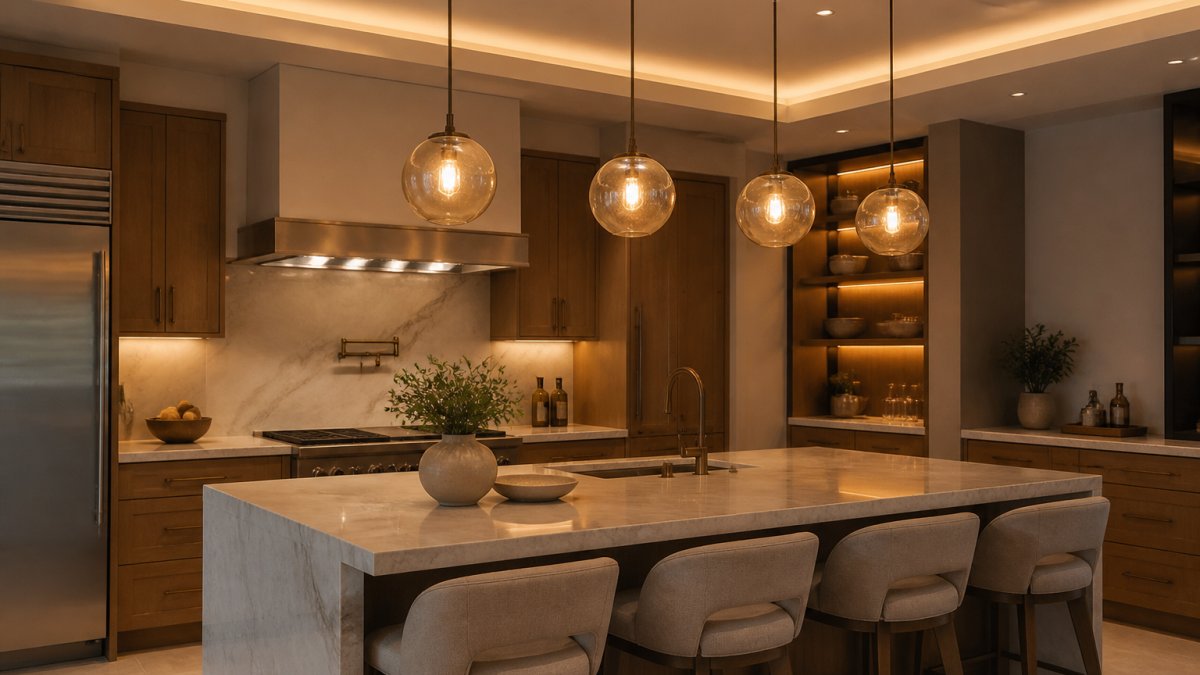
Statement pendants over an island remain a popular feature in high-end kitchen design. The shift this year is toward organic shapes, blown glass, and hand-finished metals rather than matched sets of three.
A common mistake is sizing pendants by look alone. Fixtures that are too large crowd the sightline to the room beyond; too small and they read as an afterthought.
Concealed and Integrated Architectural Lighting
Concealed lighting hides the source and reveals only the effect. Think cove lighting washing a ceiling, toe-kick strips glowing beneath cabinetry, and recessed slots that graze a stone backsplash.
Integrated lighting is generally planned before drywall rather than after.
Layered Kitchen Lighting: The Framework Behind Every Luxury Space
Layered kitchen lighting is the practice of combining ambient, task, and accent light so each layer covers what the others miss. No single fixture carries the room. This framework is central to layered lighting design.
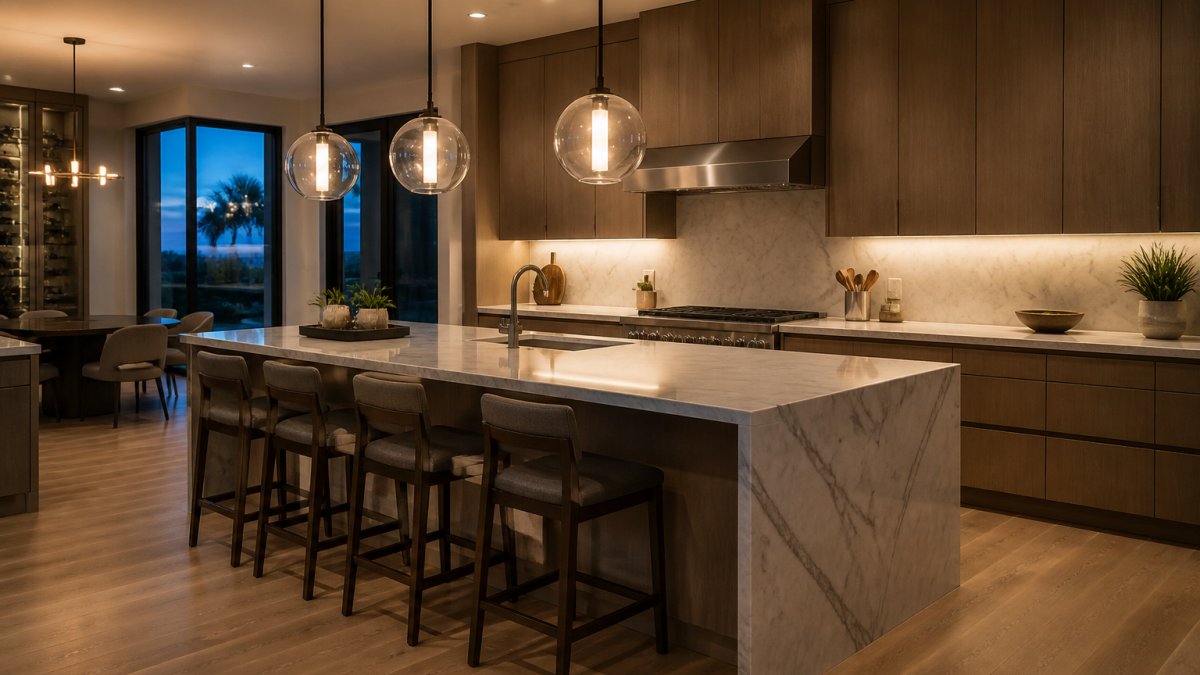
The three layers work like this:
- Ambient: overall ceiling illumination that sets the base level, recessed downlights, cove lighting, or a central decorative fixture
- Task: focused light on work surfaces, sinks, and cooktops, under-cabinet runs, pendants over the island, and dedicated sink or range lighting
- Accent: decorative and architectural light that adds depth and highlights materials, toe-kick strips, shelf lighting, wall grazers, and statement pendants
How the Layers Divide the Budget
The exact split of the lighting budget between layers depends on the room. What matters is that the split is decided before fixtures are selected, not after.
The reason is mechanical. Ambient and task layers are usually wired into the ceiling and cabinetry during rough-in, so changing them later means opening drywall or pulling cabinet panels. Accent and decorative fixtures can be swapped at almost any time.
The Layer Ratios That Make a Room Feel Right
A comfortable luxury kitchen often runs ambient light at a lower level than homeowners expect, with task light doing the heavy lifting on work surfaces.
Accent light should be the smallest share of total output but the largest share of visual drama. A toe-kick strip or a grazed stone backsplash reads as luxury precisely because it is dimmer than the working light around it. When accent light competes with task light for brightness, the room flattens.
Where Layering Goes Wrong
Three common failure modes include:
- Single-layer rooms. One row of recessed downlights across the ceiling. It is cheap, it is common, and it makes a custom kitchen look like a rental.
- Task light mounted too far back. Under-cabinet strips set against the backsplash throw the cook's shadow onto the cutting board.
- Accent light with no dimming. Toe-kick and cove lighting that only runs at full output reads as commercial, not residential. Specify dimmable drivers on every accent circuit.
Get the balance wrong and the room feels either clinical or dim. Get it right and the kitchen shifts mood with a single dimmer.
Under-Cabinet Lighting Ideas for Work Surfaces and Countertops
Under-cabinet lighting ideas have moved well past a single strip of tape light. The goal is even illumination across the countertop with no hot spots and no visible diodes.
Warm-white LED strips in an aluminum channel with a diffused lens remain the workhorse. For stone countertops, a slightly cooler temperature keeps food looking natural. For wood, warmer tones flatter the grain.
Task Lighting Placement for Food Preparation
Task lighting belongs where hands meet the surface. Place under-cabinet runs to the front edge of the upper cabinet so light lands on the counter, not on the backsplash. Over an island, pendants should sit roughly at head height when standing, angled so the light falls on the work zone.
Watch out: mounting strips too far back throws shadows exactly where you chop. It is one of the most common fixes we make on kitchens built by others.
Smart Kitchen Lighting: Scene Programming and Controls
Smart kitchen lighting turns a fixed scheme into a set of scenes. One button for cooking, one for entertaining, one for a late-night glass of water.
A well-built system groups fixtures into zones, sets dimming curves per zone, and ties scenes to time of day or a single wall keypad. For the wider picture, read Smart Home Technology for Bespoke Kitchens.
What a Scene Actually Contains
A scene is not just an on/off state. Each scene sets a level for every zone in the room, and the levels are chosen relative to each other. A typical luxury kitchen might run four scenes:
- Morning: ambient at a moderate level, task light at full, accent off, bright enough to make coffee without waking the house
- Cooking: task light at full, ambient reduced, accent off, the work surfaces carry the room and the cook's shadow is minimized
- Dinner: ambient low and warm, accent on, task light dimmed, the room reads as a dining space rather than a work space
- Late night: ambient at the lowest usable level, accent on as a path light, task off, enough to navigate without flooding the room
The scenes are only as good as the dimming curves behind them. A scene that jumps from bright to dim in the bottom 10 percent of the dimmer's range will flicker or step visibly. Specify drivers and dimmers rated for smooth low-end performance, and test the bottom of every scene before the project closes.
Controls, Keypads, and Integration
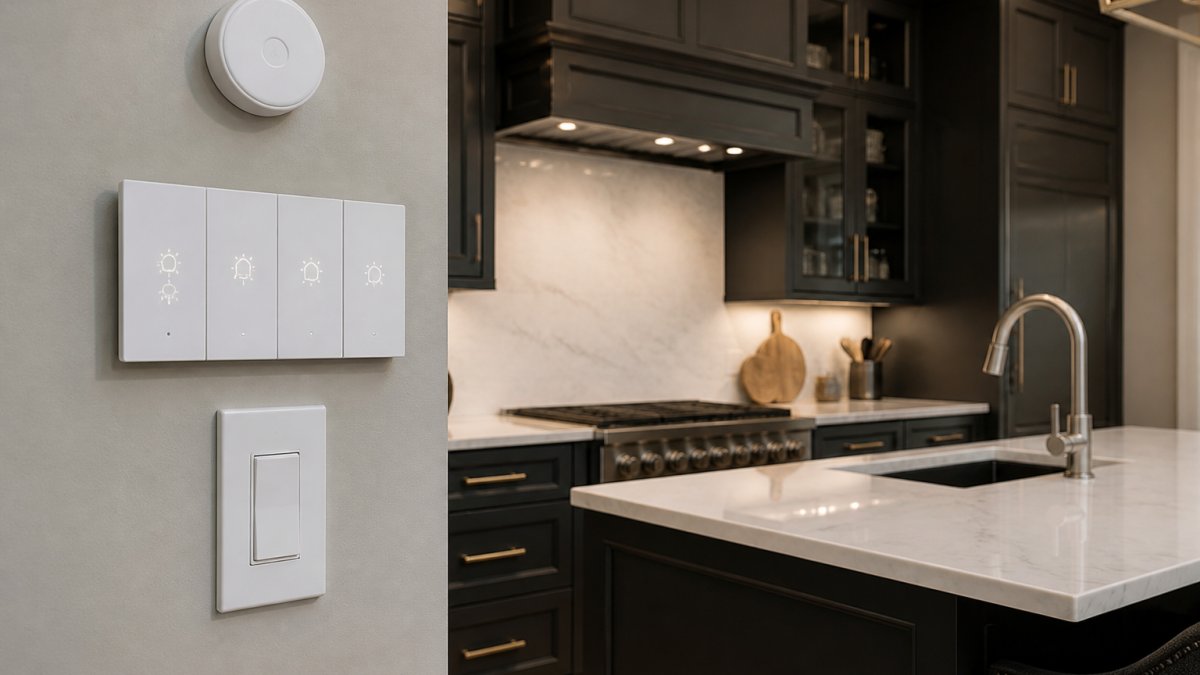
Many high-end systems use a wired or wireless control layer, with wall keypads in the kitchen and at the main entries. The keypad is what makes the system usable by everyone in the house, not just the person who programmed it.
Integration matters more than the brand of the switch. See How to Integrate Smart Appliances in Luxury Kitchen Designs for how appliances join the same system.
Technical Specifications for Luxury Kitchens
Technical specifications separate a lighting plan that ages well from one that disappoints. Four numbers matter most: color temperature, color rendering, dimming quality, and beam control.
- Color temperature: keep the whole kitchen within one family, typically warm white, so fixtures do not clash
- Color rendering (CRI): high CRI makes stone, wood, and food look true to life
- Dimming: specify drivers rated for smooth low-end dimming, or the bottom of the range will flicker
- Beam control: narrow beams for accent, wide for ambient
Glare, Shadows, and Visual Comfort
Glare is the enemy of a luxury kitchen. Bare bulbs, unshielded downlights, and polished surfaces that bounce light into the eye all undercut the design. Shield sources, use diffusers, and position recessed fixtures so they do not land in a sightline from the seating side of the island.
Shadows deserve equal attention. A single overhead source casts the cook's own shadow onto the cutting board. Layering task light from a second angle solves it.
Planning Your Kitchen Lighting by Layout and Task Zone
Planning by layout beats planning by fixture. Map the kitchen into zones first, then assign light to each.
| Zone | Primary Layer | Key Consideration |
|---|---|---|
| Island and prep | Task + accent | Pendant sizing and drop height |
| Perimeter counters | Task | Under-cabinet run placement |
| Sink and cooktop | Task | Shadow-free angle from two sides |
| Dining or seating | Ambient + accent | Dimming for evening mood |
| Display and shelving | Accent | Beam control and glare shielding |
Galley, L-shaped, and open-plan kitchens each demand a different balance. An open plan needs the lighting to transition gracefully into the living area; a galley lives or dies on task light. When you are ready to plan the full sequence, our steps for luxury kitchen remodeling walk through the process from design to final walkthrough.
Book a Lighting Design Consultation with Dimensions Luxury Builders
Lighting is the one part of a kitchen remodel that is nearly impossible to fix later without opening walls or ceilings.
As a licensed and insured Florida contractor working across Broward County, we provide end-to-end project management with one point of contact from consultation to final reveal.
Get a free quote and let us design lighting that makes your kitchen work as well as it looks. You can also explore complete home interior remodeling in Broward County.
Frequently Asked Questions
What are the latest trends in high-end kitchen lighting?
The 2026 trends favor sculptural statement pendants over islands, concealed LED strips integrated into cabinetry and ceilings, and smart controls that program scenes for cooking, dining, and entertaining. Designers are also specifying warmer color temperatures around 2700K to 3000K for ambience, paired with brighter task lighting at work surfaces. Layered kitchen lighting that combines ambient, task, and accent sources is now the standard for luxury spaces.
How do you layer lighting in a luxury kitchen?
Start with ambient lighting from recessed or ceiling fixtures to fill the room, then add task lighting such as under-cabinet strips and pendant lights over the island for food preparation. Finish with accent lighting, including toe-kick LEDs or cabinet interior lights, to highlight architectural details. Layered kitchen lighting lets you adjust each layer independently, so the room shifts from bright work mode to a softer evening atmosphere without changing a single bulb.
What color temperature is best for kitchen lighting?
Most designers recommend 2700K to 3000K for ambient and accent lighting because it flatters natural stone, wood, and painted finishes. Task lighting over countertops can run slightly cooler at 3000K to 3500K for clearer visibility during food preparation. Avoid mixing temperatures in the same sightline, since contrasting warm and cool sources makes cabinetry and countertops look uneven.
Are smart lighting controls worth it in a kitchen?
Smart kitchen lighting pays off when you entertain often or want to control multiple layers from one panel or app. Scene programming lets you set a bright cooking scene, a dimmed dinner scene, and a late-night glow with one tap. It also simplifies dimming compatibility across LED fixtures and can reduce energy use by scheduling lights to turn off automatically.
Your kitchen deserves lighting that performs as beautifully as it appears. Get started with Dimensions Luxury Builders and book a consultation to turn your lighting plan into a finished, fully managed remodel.