 ultimate-guide
7 Smart Kitchen Appliance Energy Efficiency Rules to Cut Bills
Last Updated: November 4, 2026
Quick Summary
Smart kitchen appliance energy efficiency means choosing connected appliances and configuring their schedules, sensors, and settings so the kitchen uses less electricity and water without giving up performance. The decisions made at design stage shape every utility bill afterward, so apply efficiency rules before demolition starts.
- ENERGY STAR labeled kitchen appliances meet EPA specifications above the federal minimum and are third-party verified.
- Compare models of similar size using capacity, annual energy use, and the assumptions behind the EnergyGuide estimate.
- Induction cooktops are the most energy-efficient electric cooking option because the magnetic field heats the pan directly.
- Smart appliance energy monitoring replaces guesswork with measurement and is the most useful smart feature for cutting electricity use.
- Payback is the extra upfront cost divided by annual savings, so run the numbers with your own rate and holding period.
Table of Contents
- Why Smart Kitchen Appliance Energy Efficiency Actually Matters
- ENERGY STAR Labeled Kitchen Appliances: What the Certification Covers
- Reading Energy Ratings for Electrical Appliances Without Getting Fooled
- Induction, Electric, or Gas: Cooking Methods and Electricity Use
- Smart Appliance Energy Monitoring: Measuring What Your Kitchen Really Draws
- How to Reduce Kitchen Appliance Energy Use Room by Room
- Lifecycle Cost, Payback, and What Smart Features Are Worth Paying For
- Planning a Kitchen Remodel Around Efficiency: Your Next Step
- Frequently Asked Questions
Why Smart Kitchen Appliance Energy Efficiency Actually Matters
A kitchen remodel is the moment most homeowners finally get to decide how much electricity their appliances will draw for the next decade. Smart kitchen appliance energy efficiency is the practice of choosing connected appliances and configuring their schedules, sensors, and settings so the kitchen uses less electricity and water without giving up performance. The decisions made at design stage are the ones that shape every utility bill afterward.
The stakes are straightforward. A kitchen concentrates more high-draw appliances than any other room, and most of them run daily. The U.S. Department of Energy's Energy Saver guidance notes that appliances account for a substantial share of household electricity use, and that choosing efficient models plus using them deliberately is the fastest route to lower bills.
Below, we walk through the key rules to apply when planning a kitchen, from certification labels to payback math.
ENERGY STAR Labeled Kitchen Appliances: What the Certification Covers
ENERGY STAR labeled kitchen appliances are models that meet the EPA efficiency specifications for that product category, which sit above the federal minimum. The label covers refrigerators, freezers, dishwashers, and other kitchen products, and it is verified by a third party rather than self-declared.
What the certification does not cover matters just as much. The label reflects tested energy use under standardized conditions, not how you will load the fridge or how often you run the dishwasher. A certified refrigerator packed against a hot wall still underperforms.
- Refrigerators: efficiency relative to comparable capacity and configuration
- Dishwashers: energy and water use per cycle
- Connected models: some categories now include standby and network power in testing
A common mistake is treating the label as a finish line. It is a floor, and the settings you choose after installation decide the rest.
Reading Energy Ratings for Electrical Appliances Without Getting Fooled
Energy ratings for electrical appliances are only useful when you compare like with like. The yellow EnergyGuide label gives an estimated yearly operating cost based on typical use, which is a far better comparison tool than wattage alone.
Three numbers decide the real comparison: capacity, annual energy use, and the assumptions behind the estimate. A larger refrigerator will usually use more electricity, so compare models of similar size. Dishwashers should be compared by energy per cycle and water per cycle together.
Watch out: a low headline rating on a model that is too small for your household leads to a second fridge in the garage, which wipes out the savings entirely. Size the appliance to the way you actually cook.
ENERGY STAR's product specifications publish the assumptions behind each category, so you can see whether the estimate matches your habits.
Induction, Electric, or Gas: Cooking Methods and Electricity Use
Induction cooktops are the most energy-efficient electric cooking option because the magnetic field heats the pan directly rather than the surface around it. Electric coil and radiant smoothtops lose more heat to the surrounding air. Gas stoves send a meaningful share of combustion heat past the vessel.
| Cooking Method | Heat Delivery | Kitchen Impact | Best For |
|---|---|---|---|
| Induction cooktop | Direct to pan | Fast response, cool surface | Precision cooks, sealed kitchens |
| Electric radiant | Element to glass | Slower cooldown, residual heat | Budget remodels |
| Gas stove | Open flame | Ventilation required, ambient heat | Traditional cooking styles |
The mechanism matters more than the marketing. An induction surface transfers energy into the pan through a magnetic field, so the glass around the pan stays comparatively cool and very little heat escapes into the room.
The practical difference shows up in summer. Any cooking method that heats the room pushes your air conditioning to work harder, and in a climate where the AC runs most of the year, that secondary load is real. Induction keeps more heat in the pan and less in the room.
A plug-in watt-hour meter on a 120-volt countertop appliance is straightforward, but a 240-volt range or cooktop needs a whole-circuit monitor or a smart breaker with branch-circuit metering. Run the same meal, a pot of water to a boil, then a simmer, on each cooking method and record the watt-hours.
Watch out: comparing cooking methods by nameplate wattage alone is misleading, because a 240-volt induction cooktop and a gas range are rated on different scales and the gas range's electricity draw is mostly the igniter and controls, not the cooking heat. Compare measured energy per meal, not rated input.
If you are weighing brands before committing, our guide to the 5 best luxury kitchen appliance brands compares the ranges and refrigeration lines we specify most often.
Smart Appliance Energy Monitoring: Measuring What Your Kitchen Really Draws
Smart appliance energy monitoring is the use of connected meters, app dashboards, or circuit-level sensors to track what individual appliances actually consume. For readers who want to see how smart appliances get integrated into a luxury kitchen design, our article on How to Integrate Smart Appliances in Luxury Kitchen Designs walks through the design decisions. It replaces guesswork with measurement, and it is the single most useful smart feature for reducing a kitchen's electricity use.
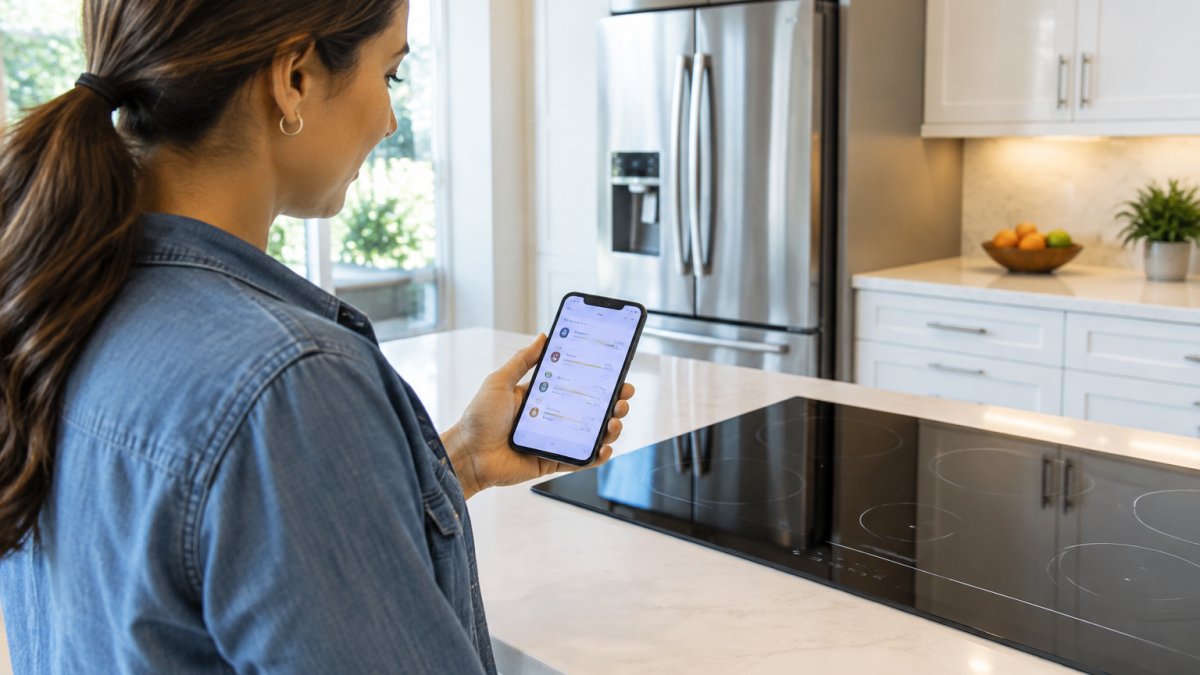
Whole-home monitoring gives you a total. Appliance-level measurement gives you the truth about the refrigerator that runs constantly or the oven that draws more than its rating suggests. Once you can see the pattern, changes become obvious: shift the dishwasher to a later schedule, replace the worst performer, or stop leaving the second fridge plugged in.
For readers planning the wider system, our article on smart home technology for bespoke kitchens covers how monitoring, lighting, and appliance controls fit together.
Monitoring only pays off if the data changes a decision. If you will not act on a weekly report, a simpler timer-based approach is enough.
How to Reduce Kitchen Appliance Energy Use Room by Room
Reducing kitchen appliance energy use comes down to settings, maintenance, and habits applied consistently. None of the individual steps is dramatic; together they compound.
Refrigeration. Set the refrigerator and freezer to the manufacturer's recommended temperatures, keep coils clean, and leave clearance around the unit for airflow. A fridge pressed into a tight cabinet works harder.
Cooking. Match pan size to burner size, use lids, and rely on the oven's convection setting when the recipe allows. Skip preheating for dishes that do not need it.
Dishwashing. Run full loads, use the eco cycle, and let dishes air-dry. Scrape rather than rinse.
Standby power. Connected appliances draw power even when idle. Group them on a smart strip or use the app's scheduling to cut network activity overnight.
Maintenance. Clean filters, descale where the water is hard, and check door seals. A worn gasket on a refrigerator is one of the most common silent energy drains we find in older kitchens.
Lifecycle Cost, Payback, and What Smart Features Are Worth Paying For
Lifecycle cost is the purchase price plus the operating cost over the appliance's service life. That framing changes which models look expensive. A unit that costs more upfront but draws less electricity and needs fewer repairs can be the cheaper choice over ten years.
Do the math in four steps, and keep the units consistent:
- Note the annual energy estimate on the EnergyGuide label, in kilowatt-hours per year (kWh/yr).
- Multiply by your all-in electricity rate in dollars per kWh, including supply and delivery charges, to get annual operating cost.
- Multiply annual operating cost by the expected service life in years.
- Add the purchase price and any known maintenance costs, then compare totals rather than stickers.
Payback is the extra upfront cost divided by the annual savings. A simple example makes the method concrete without pretending to know your rates: if a more efficient refrigerator costs $300 more and the EnergyGuide estimates differ by 100 kWh/yr, the annual savings at $0.16/kWh is $16, and payback is about 19 years, longer than many people keep the appliance.
Two adjustments most guides omit. First, utility rates vary widely by region and by rate structure, and time-of-use plans price evening and overnight hours differently. Second, smart features are not free to operate.
Smart features earn their place when they change consumption: scheduling, load sensing, leak detection, and diagnostic alerts. Features that only add convenience are worth paying for only if you value the convenience itself.
Watch out: connected appliances depend on the manufacturer's app and cloud service. Ask how long the company commits to supporting the app, and confirm the appliance still runs normally if the network drops.
If you are planning a broader efficiency project, our guide to planning an energy efficient home renovation covers the whole-house view before you commit to individual appliances.
Planning a Kitchen Remodel Around Efficiency: Your Next Step
The rules above work best when they are built into the design rather than retrofitted later. Circuit planning, ventilation, appliance clearances, and monitoring wiring are all far easier to get right before demolition starts.
Dimensions Luxury Builders manages kitchen remodels end to end, with one point of contact from design through the final walkthrough. As a licensed and insured Florida contractor, we coordinate the project so the efficiency decisions made at the design table are carried through.
Start with a complimentary design consultation and we will map the appliance plan, the monitoring approach, and the budget against the way your household actually cooks.
Frequently Asked Questions
Do smart kitchen appliances use less energy than standard appliances?
Not automatically. A smart appliance saves energy when its sensors and scheduling actually change how it runs, such as a dishwasher that delays a cycle to off-peak hours or a refrigerator that adjusts compressor cycling. The efficiency gain comes from the underlying compressor, insulation, and motor design, plus how you use the connected features. Check the yellow EnergyGuide label and ENERGY STAR listing first, then treat smart features as a bonus that helps you run the appliance at the right time.
What kitchen appliance draws the most energy?
The refrigerator usually tops the list because it runs 24 hours a day, every day. Cooking appliances draw more power in short bursts, and an electric oven or range can pull a large load while it heats. Water heating for the dishwasher and the dryer cycle add to the total. Whole-home energy monitoring or a plug-in meter on individual circuits shows your actual numbers, which vary with appliance age, size, and how often your household cooks.
Which kitchen appliances are ENERGY STAR certified?
ENERGY STAR covers refrigerators, freezers, dishwashers, electric cooktops and ranges, and range hoods, among other products. The program sets efficiency specifications that a model must meet to carry the label, and the listing is updated as standards tighten. Before buying, confirm the specific model number on the ENERGY STAR product finder rather than trusting a sticker on the showroom floor, since a brand may have certified and uncertified lines side by side.
How can I reduce the energy use of my kitchen appliances?
Start with the settings you already have: run the dishwasher only when full and use the air-dry option, match pan size to burner size, and skip preheating unless a recipe needs it. Set the refrigerator to the manufacturer's recommended temperature and keep coils clean. Use smart appliance energy monitoring to find what actually draws power in your home, then shift heavy loads like dishwashing to off-peak hours if your utility offers time-of-use rates.
The gap between an efficient kitchen and an expensive one is usually a handful of decisions made early. Bring us your plans, your appliance shortlist, and your last few utility bills, and we will show you where the load is really going. Get started with Dimensions Luxury Builders and a kitchen designed to perform for the next twenty years.