 how-to
How to Estimate Smart Kitchen Appliance Resale Value
Last Updated: November 6, 2026
Quick Summary
To estimate appliance resale value, start with the current new-equivalent retail price, apply age-based depreciation, then adjust for condition, brand strength, and whether the smart features still work. A used appliance in good condition typically fetches about half its new-equivalent price after a few years, then declines further.
- Brand reputation drives used-appliance pricing more than any other single factor.
- Appliances under 2 years old typically fetch 60-70% of new-equivalent price.
- Dishwashers depreciate fastest, so price them as functional units, not feature-rich ones.
- Use the serial number to confirm manufacture date and check for open recalls before listing.
- Remove the appliance from your manufacturer account and factory reset it before handover.
Table of Contents
- Why Smart Kitchen Appliance Resale Value Matters for Your Home
- Best Appliance Brands for Resale Value
- How to Estimate Smart Kitchen Appliance Resale Value
- Smart Kitchen Appliances Worth the Investment
- How to Sell Used Kitchen Appliances
- Appliance Resale Value vs. Value Added to the Home
- Smart-Feature Obsolescence and Transferability
- Planning a Kitchen Upgrade? Get a Free Quote from Dimensions Luxury Builders
- Frequently Asked Questions
Why Smart Kitchen Appliance Resale Value Matters for Your Home
Smart kitchen appliance resale value is the amount a buyer will pay for a used connected appliance when you sell it, trade it in, or leave it behind in a home sale.
The core tension: a premium smart range may hold strong resale value as a used appliance while adding almost nothing to your home's appraised value. Two separate markets, two separate buyers.
Below: brand strength, depreciation, condition, and smart-feature transferability, plus how to price a used unit and where to sell it.
Best Appliance Brands for Resale Value
Brand reputation drives used-appliance pricing more than any other single factor. Recognized names sell faster and for more.
Three things separate strong resale brands from weak ones:
- Parts availability. A wide service network and stocked parts make a brand easier to own, so used buyers pay more.
- Reputation for durability. Reliable compressors, motors, and control boards hold value better.
- Design consistency. Model lines that stayed visually consistent stay desirable used.
Weak resale brands share the opposite traits: limited service coverage, long parts waits, and frequent model changes.
For a closer look at which luxury names actually hold their value, see our breakdown of the 5 best luxury kitchen appliance brands.
Watch out: a premium badge alone does not guarantee resale strength.
How to Estimate Smart Kitchen Appliance Resale Value
Start with the current new-equivalent retail price, subtract age-based depreciation, then adjust for condition, brand strength, and whether the smart features still work. Apply it appliance by appliance, refrigerators, ranges, and dishwashers do not depreciate at the same rate.
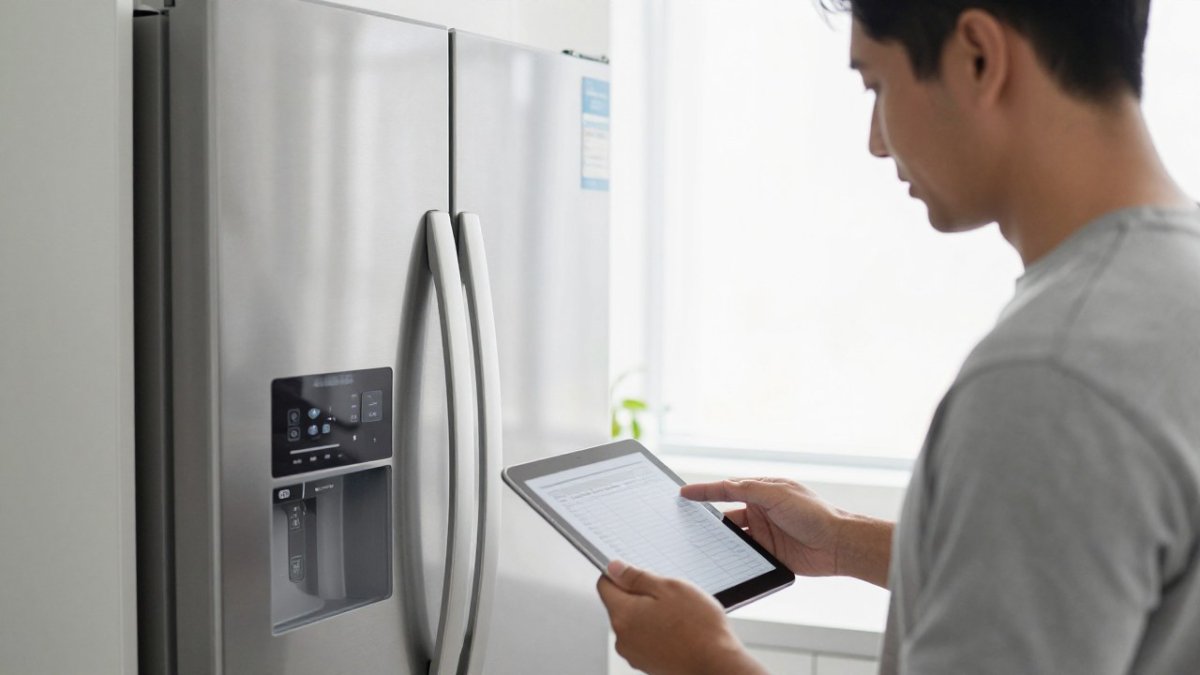
Work through these steps for each appliance:
- Find the current retail price for the closest equivalent new model, not what you paid. Match on capacity, fuel type, and feature set rather than exact SKU.
- Apply the age benchmark below for a starting estimate.
- Adjust down for scratches, dents, missing parts, or failed smart modules.
- Adjust up for a strong brand, recent service records, and working connectivity.
- Compare against local listings for the same model and age.
- Set your asking price slightly above your estimate to leave room to negotiate.
The 50/50 Rule and Depreciation Benchmarks
A simple working rule: a used appliance in good condition typically fetches about half its current new-equivalent price after a few years, then declines further. Treat that as a benchmark, not a law.
| Age of Appliance | Rough Share of New-Equivalent Price | Notes |
|---|---|---|
| Under 2 years | 60-70% | Still under or near warranty |
| 2-5 years | 40-55% | The 50/50 zone |
| 5-8 years | 25-40% | Condition matters most here |
| 8-12 years | 10-25% | Value driven by function, not brand |
| Over 12 years | Scrap or parts value | Buyers expect failure risk |
These are planning benchmarks, not quotes. Actual resale price depends on your local market, the model, and maintenance.
Appliance-by-Appliance Valuation
Each appliance type has its own buyer pool and its own depreciation curve.
- Refrigerators. The highest-ticket used appliance and most sensitive to age. Compressors and sealed systems are expensive to repair, so buyers discount heavily past year seven. Counter-depth or built-in units hold value better than freestanding. Smart cameras and diagnostics add little once the app is unsupported.
- Ranges and ovens. Gas and dual-fuel hold value better than electric in most markets. Remote preheat and temperature probes are easy to demonstrate and transfer, so they support the price. Touchscreens fail first and cost the most to replace.
- Dishwashers. The fastest depreciating major appliance. Most buyers treat a used dishwasher as a short-term stopgap, so price it as a functional unit, not a feature-rich one.
Worked Examples
These are illustrative calculations, not quotes.
- A 4-year-old connected French-door refrigerator with a current new-equivalent price of $2,400. The 2-5 year band suggests 40-55%, so $960 to $1,320. A strong brand and documented service push toward the top; one small dent pulls it back. Reasonable asking price: around $1,150, negotiating to roughly $1,000.
- A 6-year-old smart gas range with a current new-equivalent price of $1,800. The 5-8 year band suggests 25-40%, or $450 to $720. Working remote preheat and an intact control panel support the upper half. Reasonable asking price: around $650.
- A 9-year-old smart dishwasher with a current new-equivalent price of $900. The 8-12 year band suggests 10-25%, or $90 to $225. The app is no longer supported, so the smart premium is gone. Price it as a working dishwasher at around $150 and disclose the app status.
The pattern: the smart premium shrinks faster than the appliance does. Price the hardware first, then add a modest amount for features that still work and still transfer.
Standalone Resale Price vs. Value Added to the Home
Keep two numbers separate. The standalone resale price is what a used unit fetches on its own. The value added to the home is how much the appliance contributes to buyer appeal when the house sells. A premium built-in refrigerator may add real appeal to a home sale while being nearly impossible to resell separately. Use the standalone number for selling or trading in, and the home-appeal judgment for renovation decisions.
Smart Appliance Resale Value by Serial Number
The serial number is your most useful tool for an accurate estimate.
Use it like this:
- Look up the manufacture date. Age from the build date, not the purchase date.
- Check for open recalls. A recalled unit is hard to sell until the fix is documented.
- Confirm the model year. Mid-cycle revisions can change parts and features.
A common mistake is estimating age from the purchase receipt. A unit that sat in a warehouse for a year is older than the buyer thinks.
Watch out: a serial lookup showing an open recall can turn a planned sale into a repair project. Check before you list, not after a buyer asks.
Smart Kitchen Appliances Worth the Investment
The ones that lose value fastest are gimmicks: touchscreens with no clear job, apps that duplicate a button, and features locked behind a subscription.
Our shortlist of categories that tend to justify the spend:
- Smart ovens and ranges with remote preheat and precise temperature control
- Connected refrigerators with diagnostics and inventory alerts
- Smart dishwashers with cycle optimization and leak detection
If you are planning these into a larger design, our guide on integrating smart appliances into luxury kitchen designs covers placement, wiring, and network planning.
How to Sell Used Kitchen Appliances
Sell used kitchen appliances by pricing from a documented estimate, listing on the platforms local buyers use, and being upfront about age, condition, and smart-feature status. Connected appliances add a step most sellers skip: the unit must be cleaned of your data and handed over in a state the buyer can actually control.
A practical checklist before you list:
- Photograph the unit clean, in place, with the model and serial plate visible
- Note the manufacture date and any service history
- Confirm every smart feature works and say so in the listing
Reset and Transfer the Smart Features Before Handover
This is the step that separates a clean sale from a dispute. A buyer who cannot pair the appliance to their own account will ask for a refund or leave a bad review.
- Remove the appliance from your manufacturer account. Deleting the app without removing the device can leave it tied to your login.
- Factory reset the control panel. Record the steps and include them with the sale.
- Disconnect from your home network. Change your Wi-Fi password if the appliance was the only device on a guest network, or remove it from your router's client list.
Watch out: leaving your personal account linked to a sold smart appliance is a privacy risk and can expose your usage history or home network details. Reset and release the device before money changes hands.
Document Condition and Due Diligence
Buyers of used appliances are cautious, and connected units make them more so because a failed control board can cost more than the appliance is worth.
- Record a short video of the unit running, display lit, smart feature responding.
- Photograph the model and serial plate clearly enough to read.
- Keep service records and photograph them; documented repairs support a higher price.
On the buyer side, expect questions about whether the app still receives updates, whether the feature works without the cloud, and whether the unit can be paired to a new account. Have answers ready before you list.
Safe Disconnection and Pickup Logistics
Logistics decide a lot of sales. Buyers need to know the unit's dimensions, its weight, and whether they must disconnect it themselves.
- Disconnect utilities safely. Unplug the unit and shut off water to refrigerators, ice makers, and dishwashers before pickup. For gas ranges, a licensed technician should cap the line.
- Drain and dry. Empty ice makers, drain dishwasher lines, and dry interiors to prevent mold during transport.
- Measure the path. Doorways, stair turns, and elevator dimensions matter as much as appliance size. A unit that will not fit through the door is a failed sale.
Avoid Scams and Disputes
- Meet in person or use a platform with buyer protection. Overpayment scams and fake shipping agents are common in used-appliance sales.
- Do not release the appliance until payment clears. Cash, a verified peer-to-peer transfer, or a platform-held payment are safer than a personal check.
- Write a short bill of sale with the model, serial number, price, date, and an as-is statement. Both parties keep a copy.
Where to Sell
Private-sale marketplaces reach the widest local buyer pool and usually produce the highest price for working units. Trade-in programs are simpler and sometimes include haul-away and installation, but the offer is typically lower. Local demand matters: a strong market for a brand or fuel type can move the price above the benchmark, while a thin market can leave a good unit unsold for weeks.
Appliance Resale Value vs. Value Added to the Home
These are two different numbers, and confusing them leads to bad renovation decisions. Appliance resale value is what a used unit fetches on its own. Value added to the home is how much the appliance contributes to your property's price when the house sells.
A new premium range might add modest value to a home sale while holding strong resale value as a used unit. A built-in unit might add real appeal to buyers while being nearly impossible to resell separately.
For the wider picture on which projects actually pay back, see our guide to the best home improvements for resale value. And if you want to understand how a full kitchen remodel moves property value, read our analysis of why luxury kitchen renovations increase property value.
The practical takeaway: choose appliances for the home's appeal first, and treat resale as a secondary benefit.
Smart-Feature Obsolescence and Transferability
Smart features often decay faster than the appliance itself. A ten-year-old range still cooks well, but a ten-year-old control app may no longer be supported. That gap is where resale value quietly disappears.
Ask three questions before you count on a smart premium:
- Is the app still supported? Check the manufacturer's support page for the model.
- Does the feature work without the cloud? Local control survives a shutdown; cloud-only features do not.
- Does it transfer cleanly? Some platforms tie features to the original owner's account.
Transferability matters at sale. A buyer will pay more for a smart appliance they can fully control on day one. Document the reset process and hand over the setup steps with the unit.
Planning a Kitchen Upgrade? Get a Free Quote from Dimensions Luxury Builders
Estimating resale value is useful homework. The bigger decision is what goes into the kitchen in the first place.
At Dimensions Luxury Builders, we manage luxury kitchen and bathroom renovations across Broward County, from design through final walkthrough.
One client put it simply: "From the first consultation to the final reveal, the team at Dimensions made the entire process feel effortless."
If you are weighing appliance choices against resale and home value, we can help you plan a kitchen that looks right, functions well, and protects your investment. Meet our team and learn about our story, then tell us about your project.
Frequently Asked Questions
Which appliances have the best resale value?
Refrigerators, ranges, and built-in dishwashers from premium brands tend to hold the most appliance resale value. Brands with strong reputation for durability and service availability tend to retain a higher percentage of their original price. Standard models from mass-market brands depreciate faster. Condition, age, and whether the appliance is still under warranty also affect resale price.
Are smart kitchen appliances worth the investment?
Smart kitchen appliances worth the investment usually offer practical features like Wi-Fi connectivity, remote diagnostics, and energy monitoring that buyers value. However, rapid tech obsolescence can reduce long-term resale value. Focus on brands with a track record of software updates and reliable build quality. For most homeowners, smart features add convenience and modest buyer appeal, but they rarely increase home value by more than the premium paid.
How do you estimate the resale value of a used kitchen appliance?
Start with the original retail price and apply depreciation benchmarks appropriate to the appliance type and age. Adjust for brand reputation, condition, service history, and whether smart features are still supported. Check comparable listings on marketplaces for similar models. The serial number can confirm age and recall status. A professional appraisal may help for high-end luxury appliances.
Does an appliance's serial number help determine its resale value?
Yes, the serial number provides the manufacturing date, model year, and recall history. Smart appliance resale value by serial number is useful because it verifies age and whether the unit is still eligible for firmware updates or warranty coverage. Buyers often ask for the serial number to confirm authenticity and check for open recalls. Keep the serial number accessible when selling.
The smartest kitchen decisions start with a clear plan and a team that owns every step. Get started with Dimensions Luxury Builders and build a kitchen that earns its place in your home.