 how-to
How to Choose Custom Kitchen Cabinets in Florida
Table of Contents
- Start With Your Kitchen Layout and Storage Needs
- Custom Kitchen Cabinet Materials That Handle Florida Humidity
- Custom Kitchen Cabinet Styles and Finishes for Modern Homes
- Custom Cabinet Maker Questions to Ask Before You Sign
- Custom Kitchen Cabinet Installation Timeline and What to Expect
- Comparing Custom, Semi-Custom, and Stock Cabinets
- Conclusion: Choosing the Right Custom Kitchen Cabinets
- Frequently Asked Questions
Last Updated: October 6, 2026
Start With Your Kitchen Layout and Storage Needs
Choosing custom kitchen cabinets in Florida starts with the room itself, not the catalog. Before you compare door styles or finishes, map how your household actually uses the kitchen: how many people cook at once, where traffic flows, and what you store most.
At Dimensions Luxury Builders, we have managed full kitchen remodels across Broward County, and the projects that go smoothly share one trait. The layout was settled before a single cabinet was ordered.
Measure the work triangle first: the distance between your sink, range, and refrigerator. A cramped triangle makes even a beautiful kitchen frustrating to cook in. Then account for the storage you genuinely need, not just the storage you see in showrooms.
- Base cabinets: deep drawers for pots, pans, and small appliances
- Upper cabinets: shallow shelves for daily dishes and glassware
- Tall cabinets: pull-out pantries and integrated appliance garages
- Corner solutions: lazy Susans, blind-corner pullouts, and diagonal access
Once the layout works, material selection becomes a decision you can make with confidence.
Custom Kitchen Cabinet Materials That Handle Florida Humidity
Humidity is the deciding factor for custom kitchen cabinet materials in South Florida. Heat and moisture cause lower-grade cabinet boxes to swell, warp, and delaminate, so material choice matters more here than in drier climates.
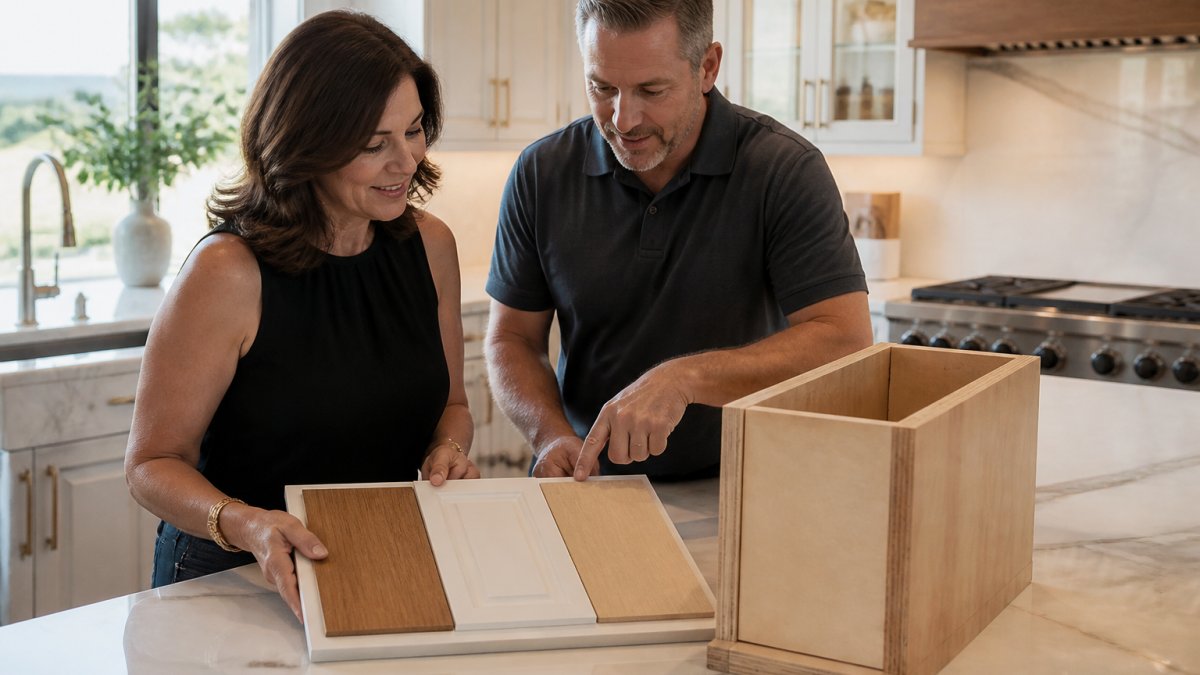
Cabinet boxes are the structural frames behind your doors. Cabinet doors and drawer fronts are the visible faces. Hinges and drawer slides are the moving parts that determine how the kitchen feels day to day.
How Humidity Actually Damages Cabinets
Moisture damage is rarely about a single splash. It is a cycle:
- Absorption: unfinished or poorly sealed edges and cores take in airborne moisture.
- Swelling: particleboard and low-grade MDF expand at the core, permanently deforming the panel.
- Delamination: the veneer or laminate skin separates from the swollen core.
- Hardware failure: swollen panels push hinges and slides out of alignment, and screws lose their grip.
This is why the cut edges of a cabinet box matter as much as the face. A plywood box with raw, unsealed edges will absorb moisture through those edges even if the face is finished. Ask any maker how they seal the exposed edges of boxes, shelves, and toe kicks.
Solid Wood, Plywood, and MDF Compared for Moisture Resistance
Solid wood offers the best long-term durability and can be sanded and refinished, but it expands and contracts with humidity changes. Plywood holds up well in moist conditions because its layered construction resists warping. MDF gives you a smooth, uniform surface for painted finishes, though it swells badly if water reaches the core.
| Material | Moisture Resistance | Best For | Watch Out For |
|---|---|---|---|
| Solid wood | High, with proper sealing | Doors, drawer fronts, visible faces | Seasonal expansion and contraction |
| Plywood | High | Cabinet boxes, shelving | Lower grades with voids or gaps |
| MDF | Moderate | Painted doors, flat panels | Swelling if the core gets wet |
| Particleboard | Low | Rarely appropriate in humid kitchens | Swells fast; hardware pulls loose |
For a Florida kitchen, we recommend plywood boxes paired with solid wood or quality painted MDF fronts. That combination balances moisture resistance with the finish options homeowners want.
A Practical Selection Sequence for Humid Kitchens
Work through these checks in order before you commit:
- Specify the box material and grade. Ask for plywood with a defined thickness (commonly 1/2 inch to 3/4 inch) and confirm there are no voids in the core.
- Confirm edge sealing. Every exposed edge, shelves, box sides, toe kicks, should be banded or sealed, not left raw.
- Choose a factory-applied finish. Factory finishes cure in controlled conditions and hold up better than site-painted surfaces in moist air.
- Match hardware to the environment. Look for corrosion-resistant hinges and slides rated for humid or coastal conditions.
- Plan ventilation. A range hood vented to the exterior and a properly sized exhaust reduce the moisture load the cabinets face daily.
U.S. Department of Energy guidance on indoor humidity and moisture control
Once the layout works and the materials are specified for moisture, you can move on to style and finish with confidence.
Custom Kitchen Cabinet Styles and Finishes for Modern Homes
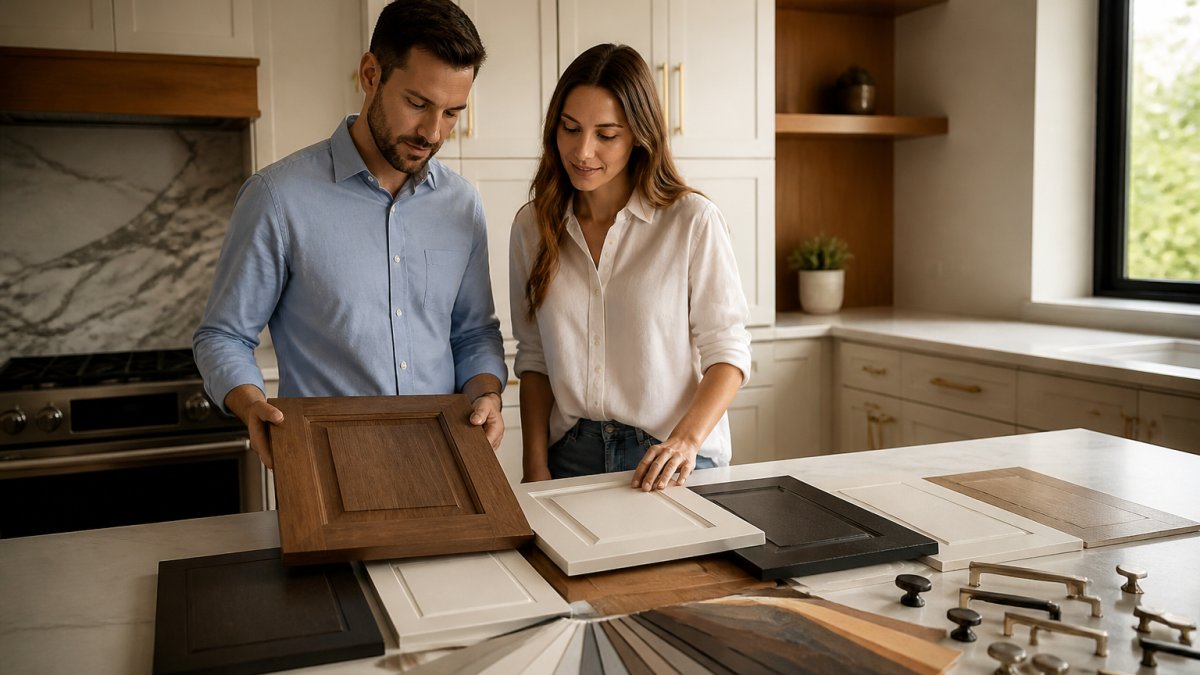
Style is where most homeowners start, and it is usually the easiest decision to make. Custom kitchen cabinet styles fall into a few broad families, and each one reads differently depending on your finish.
Shaker cabinets remain the most requested style for modern homes. Their recessed center panel suits both traditional and contemporary kitchens. Flat-panel and slab doors lean more minimal, while raised-panel designs add traditional weight to a space.
Finish choices shape how a kitchen ages:
- Painted cabinets in white or soft neutrals brighten smaller kitchens
- Two-tone cabinets pair a lighter upper with a darker lower for visual depth
- Wood cabinets with a natural stain show grain and warmth
- Modern cabinets in matte finishes resist fingerprints and glare
Custom Cabinet Maker Questions to Ask Before You Sign
The right custom cabinet maker protects your investment as much as the materials do. Ask direct questions before signing anything, and treat vague answers as a warning sign.
- Are you licensed and insured in Florida, and can you show proof?
- Where are the cabinets built, and what is the lead time?
- What grade of plywood or MDF goes into the boxes?
- What hardware brands do you use, and what is the warranty?
- How do you handle humidity-related issues after installation?
That last question separates serious makers from order-takers. A maker who has worked in South Florida for years will have a clear answer about sealing, ventilation, and finish selection for moist air.
Custom Kitchen Cabinet Installation Timeline and What to Expect
A realistic custom kitchen cabinet installation timeline runs several weeks from final measurement to completion, and the cabinet build itself is usually the longest phase. Custom cabinets are made to your dimensions, so they are not sitting in a warehouse waiting to ship.
Here is how the phases typically break down:
- Design and measurement: finalize layout, materials, and finish
- Order and fabrication: cabinets are built to specification
- Delivery: boxes arrive and are inspected for damage
- Installation: boxes are leveled, secured, and doors hung
- Finishing touches: hardware, trim, and adjustments
- Final walkthrough: you review the work before sign-off
Expect the room to be unusable for part of this window. Plan temporary cooking arrangements and clear the space ahead of time.
Comparing Custom, Semi-Custom, and Stock Cabinets
Custom, semi-custom, and stock cabinets differ mainly in fit, material options, and how long you wait. Custom cabinets are built to your exact dimensions with your chosen materials and finish. Semi-custom uses standard sizes with some customization. Stock cabinets come in fixed sizes you buy off the shelf.
| Option | Fit | Lead Time | Best For |
|---|---|---|---|
| Custom | Exact dimensions | Longest | Irregular layouts, high-end finishes |
| Semi-custom | Near-exact | Moderate | Standard kitchens needing some flexibility |
| Stock | Fixed sizes | Shortest | Quick updates on a tight timeline |
For older South Florida homes with uneven walls and non-standard openings, custom cabinets are often the only option that fits cleanly. Stock cabinets can work in newer construction with square, predictable dimensions.
How to Build a Cabinet Budget That Holds Up
Most homeowners underestimate the total because they price only the cabinets. The real project cost is a stack of line items, and each one should appear on your quote:
- Cabinet boxes and doors, the largest line, driven by material, size, and finish
- Hardware, hinges, slides, pulls, and soft-close mechanisms
- Trim and fillers, crown, toe kicks, and panels that finish the run
- Delivery and freight, custom orders often ship from out of state
- Installation labor, leveling, securing, and hanging
- Countertop and backsplash, frequently quoted separately from cabinets
- Electrical, plumbing, and drywall, often triggered by layout changes
- Permits and inspections, required for many remodels
A common pattern is that the cabinets are only part of the total, with installation, countertops, and trades making up a substantial share. Ask each bidder to break out these categories so you can compare like for like.
How to Compare Quotes Without Getting Burned
A single lump-sum number tells you almost nothing. Use this checklist to compare bids side by side:
- Same scope? Confirm every quote covers the same cabinet count, sizes, and finish.
- Same materials? Verify the box material, door material, and hardware brand are identical across bids.
- Same inclusions? Check whether delivery, installation, trim, and disposal are in or out.
- Same timeline? Compare lead times and installation windows, not just price.
- Same warranty? Read what is covered and for how long.
Where the Money Actually Goes
When you look at a quote, the cabinet line itself splits into components: boxes, doors and drawer fronts, hardware, and finish. Two bids can look similar at the top line but differ sharply underneath, one uses plywood boxes and name-brand slides, the other uses particleboard and generic hardware. That difference is invisible in a lump sum and obvious in an itemized quote.
Request itemized quotes from at least three makers, and ask each to state the box material, door material, hardware brand, and warranty term in writing. That single habit is the most reliable way to protect your budget.
U.S. Environmental Protection Agency information on formaldehyde in engineered wood products
Conclusion: Choosing the Right Custom Kitchen Cabinets
Getting custom kitchen cabinets right in a humid climate comes down to preparation: settle the layout, choose moisture-resistant materials, and vet your maker before you sign. That is the difference between cabinets that look good on day one and cabinets that still perform years later.
At Dimensions Luxury Builders, we handle the entire process for Broward County homeowners, from design consultation to final walkthrough. As a licensed and insured Florida contractor, we bring local supplier access, faster permitting, and end-to-end project management with one point of contact.
Get a Free Quote from Dimensions Luxury Builders and start your kitchen with a team that manages every detail from first measurement to final reveal.
Frequently Asked Questions
What should I consider when choosing custom kitchen cabinets?
Start with your kitchen layout and storage needs, then select materials rated for humidity, such as plywood boxes and solid wood doors. Confirm the cabinet style and finish you want, ask the cabinet maker about construction methods, and review the installation timeline. In Florida, moisture resistance is a top priority because year-round humidity can warp lower-grade materials over time.
Are custom kitchen cabinets worth the cost?
Custom cabinets are worth it when your kitchen has unusual dimensions or you need specific storage. They offer better material quality, precise fit, and long-term durability compared to stock options. For homeowners planning to stay in their home for years, the investment often pays off through improved functionality and higher resale appeal. Request a detailed quote to compare against semi-custom alternatives.
What cabinet materials work well in humid climates?
Plywood cabinet boxes and solid wood or high-quality MDF doors with a factory-applied finish hold up best in humid climates. Avoid particleboard boxes, which swell when exposed to moisture. Plywood resists warping and holds screws better over time. Ask your cabinet maker what moisture-resistant coatings or edge-sealing methods they use on all cabinet surfaces.
How long does it take to design and install custom kitchen cabinets?
The full process typically runs 8 to 14 weeks from initial design to final installation. Design and measurement take 1 to 2 weeks, fabrication runs 6 to 10 weeks depending on the cabinet maker's backlog, and installation takes 2 to 5 days. Permitting and inspection can add time. Ask your contractor for a written timeline with milestones before work begins.