 comparison
Luxury Kitchen Countertop Alternatives to Marble
Table of Contents
- Why Homeowners Choose Marble Alternatives
- Quartzite vs Marble Countertops: The Natural Stone Comparison
- Marble-Look Quartz Countertops: Engineered Luxury
- Porcelain Countertops That Look Like Marble
- Granite: The Durable Natural Stone Alternative
- Low-Maintenance Marble-Look Countertops: Care and Durability
- Selecting and Installing Your Marble Alternative
- Frequently Asked Questions
Last Updated: October 8, 2026
Why Homeowners Choose Marble Alternatives
Marble symbolizes luxury in kitchen design, but it stains easily, etches under acidic foods, requires frequent sealing, and costs more than engineered alternatives. Homeowners seeking marble's aesthetic without the maintenance burden turn to marble countertop alternatives that deliver luxury looks with superior durability and easier care.
The right marble alternative depends on your lifestyle, design preferences, and long-term vision.
This guide compares the best marble countertop alternatives by appearance, durability, maintenance, and realistic costs.
Quartzite vs Marble Countertops: The Natural Stone Comparison
Quartzite is a natural stone formed from quartz sandstone under intense heat and pressure. Unlike marble, it is significantly harder and more resistant to etching and staining, delivering authentic natural stone with marble's visual appeal but superior performance.
Quartzite features white, gray, or blush tones with dramatic veining resembling marble, and resists scratches, heat, and acids far better. It still needs periodic sealing (every 1-3 years), but far less often than marble, handling an active kitchen while keeping a luxurious natural-stone aesthetic.
Both offer unique veining: marble tends toward softer, flowing patterns, while quartzite shows bolder, more angular veining. Over time, quartzite stays beautiful with reasonable care, while marble requires vigilant maintenance or shows visible wear within years.
Marble-Look Quartz Countertops: Engineered Luxury
Engineered quartz combines crushed quartz (about 90%) with resin binders and pigments to create slabs that mimic natural stone while eliminating most of marble's vulnerabilities. Modern manufacturing is sophisticated enough that distinguishing it from natural marble requires close inspection.
Why Quartz Mimics Marble So Effectively
Quartz manufacturers use advanced pigmentation and layering to reproduce marble's subtle color gradations and flowing lines, delivering a marble-look quartz countertop without the maintenance burden.
Quartz offers practical advantages marble cannot match: the non-porous surface resists staining completely, so spilled wine, lemon juice, or cooking oil wipes away. No sealing is ever required, and scratch resistance far exceeds marble. For busy households that value low-maintenance luxury, quartz delivers the look with real-kitchen performance.
Quartz typically costs less than quartzite or marble, making luxury aesthetics accessible at a lower price point, and its engineered consistency means fewer fabrication surprises than natural stone's variability.
Porcelain Countertops That Look Like Marble
Porcelain has moved from bathroom walls to luxury kitchen islands because modern large-format slabs reproduce marble's veining with fidelity impossible a decade ago. Digital printing applies the pattern across the full slab face, so veining runs continuously rather than repeating in obvious tiles. For a Calacatta or Statuario look without marble's etching problem, porcelain is a legitimate contender.
Formats, Thicknesses, and Fabrication Realities
Most luxury-grade porcelain slabs come in jumbo formats, commonly around 63 by 126 inches, in thicknesses of roughly 6 mm, 12 mm, and 20 mm. The 6 mm and 12 mm slabs are typically laminated to a substrate (often honeycomb or fiber-cement) for stiffness, while 20 mm slabs can sometimes be self-supporting with proper cabinetry. Thickness drives the edge profile: a 6 mm slab laminated to a thick core can be built up to a chunky mitered edge that reads like 2-inch stone, while 12 mm gives a slimmer, more modern profile.
Fabrication is where porcelain separates itself from quartz and natural stone. It is brittle relative to its hardness, so cutting, mitering, and polishing require water-fed tooling and experienced fabricators. Ask whether your fabricator has a porcelain-specific blade and a track record with jumbo slabs, a botched cut on a 126-inch slab is expensive.
Where Porcelain Beats Marble, and Where It Doesn't
Porcelain is non-porous, so red wine, lemon juice, and oil sit on the surface rather than soaking in. It resists heat well enough that a hot pan set down briefly is generally fine, though thermal shock on a cold slab is a real risk, and it resists scratching better than marble. Cleaning is soap and water or a pH-neutral cleaner; no sealing, ever.
The trade-offs are worth naming. Seams exist, and on a long run you will have at least one; modern epoxy and color-matched adhesives make joints nearly invisible on a patterned slab, but they are not zero. Chipping at an exposed edge is possible with a hard impact, and while a skilled fabricator can often repair a chip with color-matched resin, the repair is visible on close inspection. Porcelain also cannot be refinished, once the printed wear layer is compromised, the slab is replaced, not polished out.
Finish Options and the Luxury Angle
Porcelain slabs come in polished, matte, and a soft-touch or silk finish between the two. Polished porcelain gives the glossy look of polished marble, while matte and silk read as more contemporary, hide fingerprints and water spots better, and pair well with leathered and honed natural stones. Bookmatching two slabs so the veining mirrors across a seam is achievable with porcelain, one of the few ways to get a true bookmatched marble look without natural-stone prices or maintenance.
Porcelain tile and slab standards and installation guidance
Granite: The Durable Natural Stone Alternative
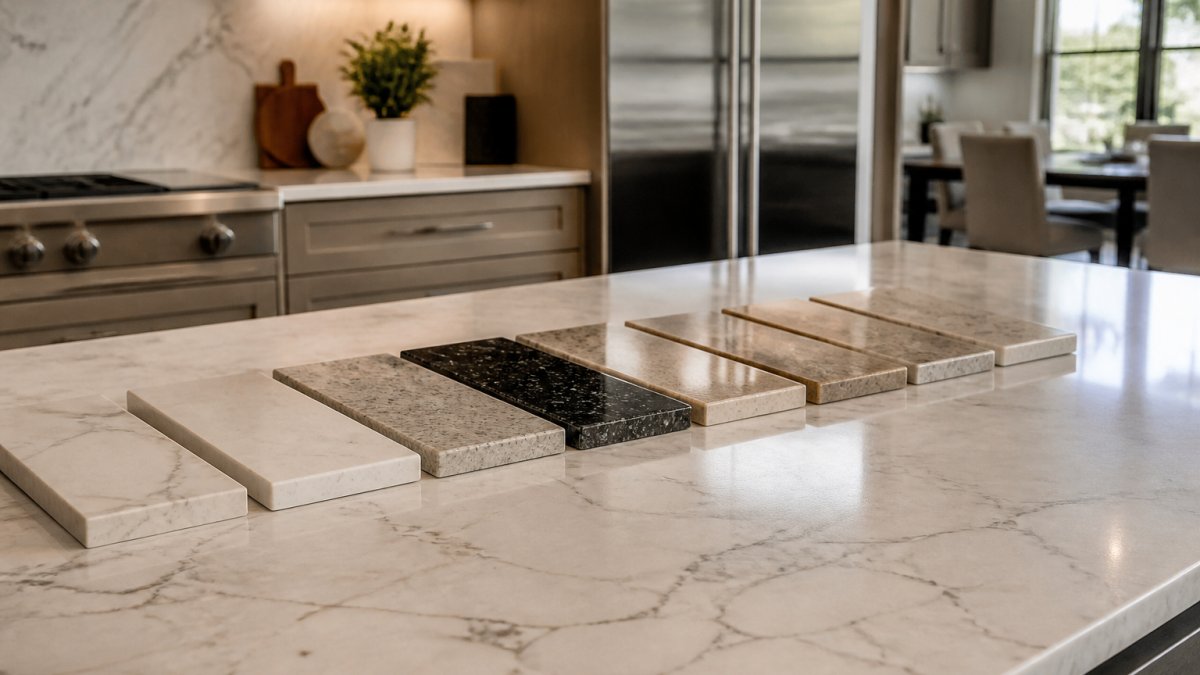
Granite deserves consideration as a marble alternative, especially for those committed to natural stone. It is harder than marble, more resistant to scratching and heat, and comes in diverse palettes, from classic blacks and grays to warm reds and golds.
Granite requires sealing like marble, typically every 1-3 years, but its superior hardness means it handles daily kitchen use better, resists etching from acids, and won't show the wear patterns marble develops in high-traffic kitchens.
Granite's speckled, granular appearance differs from marble's flowing veining. If your design requires marble's characteristic look, granite won't deliver it, but if you're open to a different natural-stone aesthetic with better performance, granite provides genuine luxury with practical durability.
Low-Maintenance Marble-Look Countertops: Care and Durability
"Low maintenance" is the phrase every marble-alternative article leans on, and almost none define it. The useful version is a scorecard across six conditions every kitchen produces: heat, staining, scratching, impact, UV exposure, and repairability. Here is how the leading marble alternatives compare, plus the care and repair guidance most guides skip.
Performance Scorecard
Heat. Quartzite, granite, and porcelain handle a hot pan set down briefly without damage.
Staining. Quartz, porcelain, and solid-surface are effectively stain-proof. Quartzite and granite resist staining well when properly sealed but can absorb oil and wine if the sealer has worn.
Scratching. Quartzite and granite are the most scratch-resistant natural options. Porcelain is highly scratch-resistant on its face but can chip at edges. Quartz scratches less than marble but more than quartzite.
Impact. Granite and quartzite tolerate impact best. Quartz is tough but can chip at an edge under a hard blow. Porcelain chips at edges more readily than other premium options.
UV exposure. Quartz, porcelain, and solid-surface are color-stable in normal interior light.
Repairability. This is the column most articles omit. Solid-surface is most repairable, scratches and burns can be sanded and refinished on site. Quartz can sometimes be repaired with color-matched resin, but a scorch mark usually means replacement.
Sealing: What Actually Needs It and How Often
Sealing is the most misunderstood maintenance task in kitchen design. The rule is simple: porous natural stone needs sealing, non-porous engineered surfaces do not.
- Marble: reseal roughly every 6 to 12 months in an active kitchen. Acidic foods etch the surface regardless of sealer.
- Quartzite: reseal every 1 to 3 years depending on use and the specific slab's porosity. Some dense quartzites hold a sealer far longer.
- Granite: reseal every 1 to 3 years. A simple water test, a few drops left on the surface for 15 minutes, tells you whether the sealer is still working.
- Soapstone: does not require sealing in the traditional sense, but benefits from periodic mineral-oil treatment to even out the natural darkening.
- Quartz, porcelain, solid-surface: no sealing required.
Stain Removal and Repair by Material
For oil-based stains on sealed natural stone, a poultice, a paste of baking soda or diatomaceous earth with a solvent, drawn under plastic wrap for 24 to 48 hours is the standard remedy. For organic stains like coffee or wine, a hydrogen-peroxide poultice is often effective. Etch marks on marble are surface corrosion, fixed by polishing or honing, not cleaning.
Chips on quartz, quartzite, granite, or porcelain are typically repaired with color-matched epoxy or polyester resin by a fabricator or stone restoration specialist. The repair is durable but visible on close inspection, especially on a polished surface. Scratches on solid-surface can be sanded out by the homeowner with the manufacturer's kit; scratches on quartz and natural stone generally require a professional.
Choosing by Household
The right material depends less on aesthetics than on who uses the kitchen. A household that cooks hard, entertains often, and wants zero maintenance is best served by quartz or porcelain. A homeowner who wants natural stone and will reseal every year or two should look at quartzite or granite. A design-led household that values refinishing a surface over decades may prefer marble or soapstone and accept the care. A rental or short-hold property is usually best served by quartz or high-quality solid-surface, where durability and repairability matter more than slab uniqueness.
Natural Stone Institute guidance on stone care and sealing
Selecting and Installing Your Marble Alternative
Choosing the right marble countertop alternative starts with your design vision: do you want a surface that looks virtually identical to marble, or are you open to different aesthetics that still convey luxury?
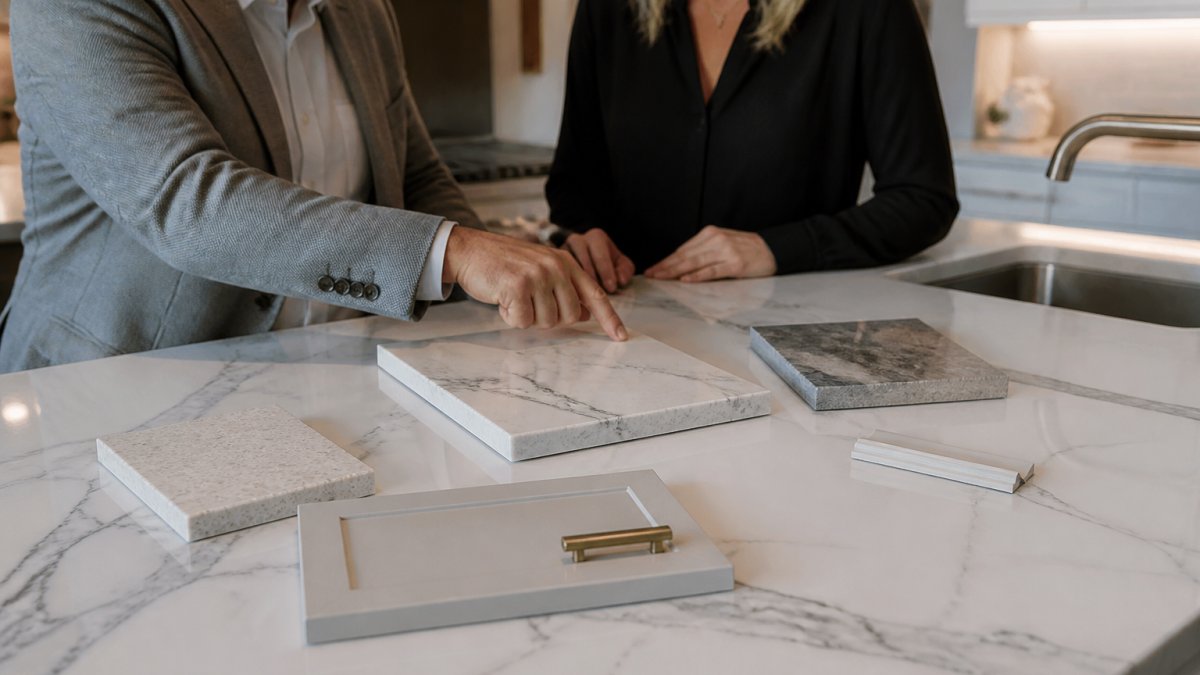
Budget considerations extend beyond material cost to installation and long-term maintenance. Quartz and porcelain have lower total-cost-of-ownership because they eliminate sealing expenses. Natural stone requires ongoing maintenance investment.
Installation quality matters significantly. Proper sealing (for materials requiring it), seamless edge finishing, and correct support structure ensure your countertops perform as intended, while edge profiles, finish selection (polished, honed, leathered), and slab orientation influence the visual result.
Our team guides clients through material selection, fabrication, and installation logistics, managing the process from design consultation through final installation so your marble alternative delivers the luxury appearance and performance you envision.
| Material | Best For | Maintenance | Appearance Match |
|---|---|---|---|
| Quartz | Low-maintenance luxury | Minimal (no sealing) | Excellent marble replication |
| Quartzite | Natural stone durability | Moderate (periodic sealing) | Very close to marble |
| Porcelain | Seamless luxury | Minimal (no sealing) | Excellent marble replication |
| Granite | Natural stone variety | Moderate (periodic sealing) | Different aesthetic |
Selecting a marble countertop alternative is ultimately about matching material performance to your actual kitchen life. Engineered quartz and porcelain deliver marble's aesthetic with worry-free durability, ideal for households prioritizing ease of use alongside luxury appearance. Quartzite and granite offer natural-stone authenticity with varying maintenance demands.
Frequently Asked Questions
What material looks like marble but is cheaper?
Quartz and porcelain engineered countertops offer the veining and color of marble at lower cost than natural stone. Quartz, made from crushed stone and resin, resists staining and etching better than marble while maintaining that luxury aesthetic. Porcelain provides similar visual appeal with excellent durability. Both require less sealing and maintenance than marble, making them practical for busy kitchens.
Is quartzite a better choice than marble for kitchen countertops?
Quartzite offers superior durability compared to marble. It resists scratching, staining, and heat damage far better, making it ideal for high-traffic kitchens. However, quartzite is still a natural stone requiring periodic sealing. Marble remains the choice if you prioritize aesthetics over performance; quartzite is better if you want marble's look with marble-alternative durability and lower maintenance demands.
Which marble alternative is the most durable?
Engineered quartz and porcelain are the most durable marble alternatives. Both resist scratches, stains, and heat without requiring sealing. Quartzite, while harder than marble, still needs occasional sealing. For kitchens with heavy use, quartz and porcelain outperform natural stone alternatives. Granite also ranks high in durability but requires sealing like quartzite.
What countertop material looks most like Carrara marble?
Engineered quartz and porcelain specifically designed with white veining mimic Carrara marble most closely. Brands engineer these surfaces to replicate Carrara's distinctive gray and white veining patterns. Quartzite can also resemble Carrara, though natural variation means each slab differs. For consistent Carrara-like appearance, engineered options provide the most reliable visual match.