 comparison
How to Choose a Walk-In Shower Door for Seniors
Quick Summary
The best walk-in shower door depends on the person's mobility, the room's layout, and whether a caregiver needs to help. Hinged swing doors give the widest opening, sliding doors suit small bathrooms, and doorless entries offer the lowest threshold for walker or wheelchair users. Measure the clear opening at its narrowest point before you choose.
- A hinged swing door opening outward into the room is usually safer for a seated user.
- Sliding doors open only partway, so confirm the clear opening dimension before buying.
- A doorless entry needs a properly sloped floor and a glass screen to control splash.
- Measure the opening at the narrowest point, including any fixed panel or stop.
- Request itemized quotes so the door, floor work, and accessories can be compared fairly.
Table of Contents
- Walk-In Shower Door Options for Seniors: Side-by-Side Comparison
- Sliding Shower Doors for Seniors: Where They Work and Where They Don't
- Doorless Walk-In Showers for Seniors: Safety Trade-Offs and Water Control
- Walk-In Showers for Seniors with Seat: Layout, Clearance, and Fit
- Walk-In Shower Door Options for Seniors Cost: What Drives the Price
- Choosing Your Senior-Friendly Shower Door: Next Steps With Dimensions Luxury Builders
- Frequently Asked Questions
Why the Shower Door Matters More Than the Shower Itself for Seniors
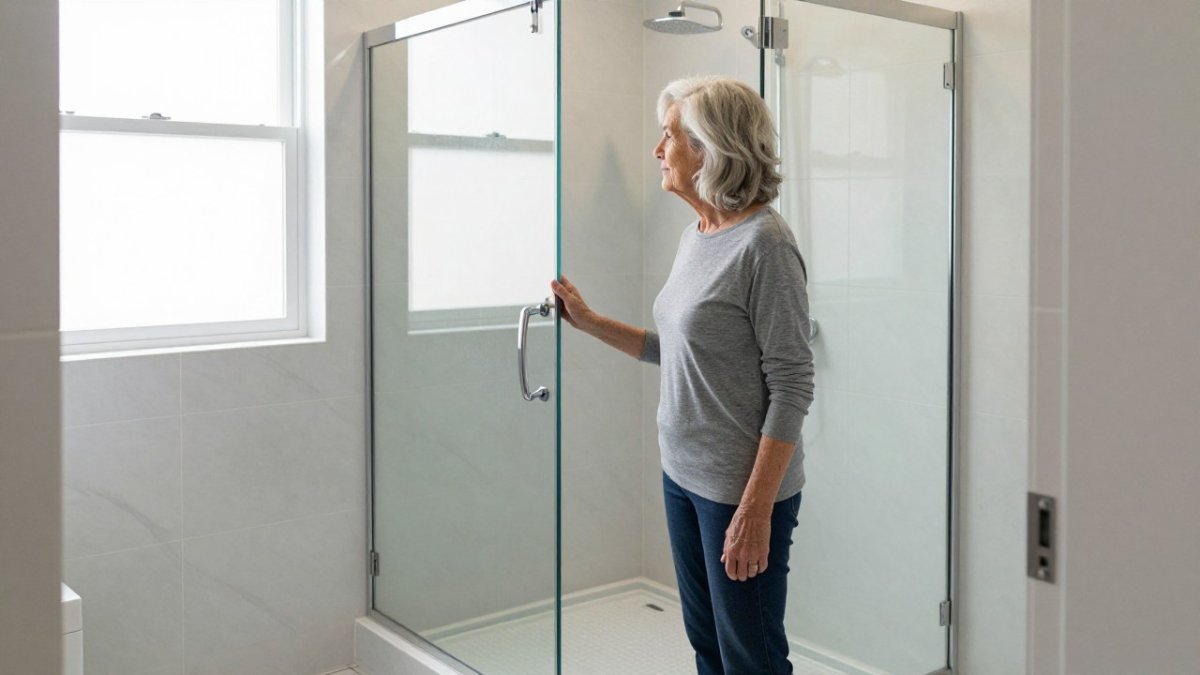
Bathroom remodels across Broward County often hinge on the door, which is frequently the part homeowners underestimate. A walk-in shower with a low threshold and a well-chosen door can make bathing safer and easier for an older adult, while the wrong door can turn the same space into a hazard. The door controls how someone enters, how they hold on to the frame, how much water escapes, and whether a caregiver can help in an emergency.
Falls in the bathroom are a serious concern for older adults, and the Centers for Disease Control and Prevention (CDC) tracks fall injuries as a leading cause of injury among people aged 65 and older. CDC older adult fall prevention resources
A shower door affects that risk in three specific ways. It sets the height and width of the entry, it determines what the person can grip when stepping in and out, and it governs how wet the floor becomes. Each of these matters more than the decorative look of the glass.
Many families focus on finishes first. A better starting point is to ask how the person will move through the space on their worst day, not their best one.
Walk-In Shower Door Options for Seniors: Side-by-Side Comparison
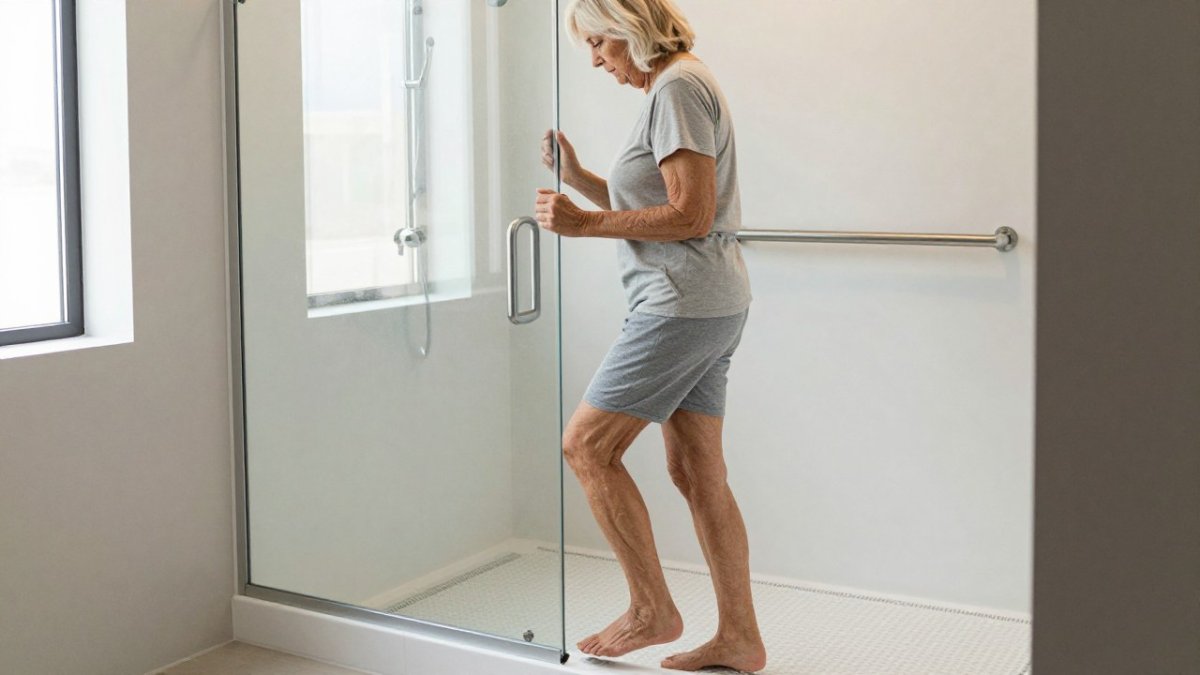
The four most common door styles each solve a different problem. The right choice depends on the person's mobility, the room's layout, and whether a caregiver needs to assist. The table below compares them on the criteria that actually decide the purchase: how wide the opening is, how hard the door is to operate, how easily a caregiver can reach a seated user, and how much water the design contains.
| Door Type | Typical Opening | Operating Effort | Caregiver Access | Water Containment | Best For |
|---|---|---|---|---|---|
| Hinged swing door | Full width when open | Pull or push to unlatch; moderate grip needed | Good, door swings clear | Strong | Users who stand and can operate a handle |
| Sliding door | Partial, often half the width | Low force, but grip and reach required | Limited by the fixed panel | Strong | Tight bathrooms, seated users who can reach the handle |
| Doorless (curbless) entry | Full width, no door | None | Best, unobstructed | Depends on slope and screen | Caregiver-assisted bathing, walker or wheelchair users |
| Bi-fold or pivot door | Varies by configuration | Moderate; hinges and pivots wear | Fair, panels fold into the opening | Moderate | Medium-width openings where swing space is limited |
Hinged swing doors are the familiar choice. They open wide, which helps a caregiver reach the user quickly. The pros are a full-width opening and a sturdy frame that can double as a grip point. The cons are the swing path, which needs open floor space, and the risk of the door striking a person standing close behind it.
Sliding doors suit small bathrooms because they do not swing into the room. The pros are space efficiency and a simple operating motion. The cons are a partial opening and a track that collects soap residue. A sliding door typically opens only partway, so a wheelchair or a caregiver assisting a person may find the gap too narrow.
Doorless or curbless entries offer the lowest threshold and the easiest step-in. The pros are unobstructed access and caregiver friendliness. The cons are water containment, which requires careful floor slope and a glass panel or wall to manage splash. Many contractors recommend a fixed panel rather than no barrier at all, because it limits splash while keeping the entry open.
Bi-fold and pivot doors split the difference. A bi-fold folds back on itself and needs less swing clearance than a hinged door, while a pivot door rotates on a vertical or offset axis. Both mechanisms have more moving parts than a simple hinge, so they need periodic adjustment and are more sensitive to hard-water buildup.
Match the door to the mobility need, not the showroom. A person who uses a walker and needs a caregiver present is usually best served by a doorless entry with a fixed panel. A person who stands independently but has reduced grip strength may do better with a sliding door with a large, easy-to-grip handle.
Watch out: a door that looks accessible in a showroom can fail in a real bathroom if the clear opening is measured to the frame rather than to the widest point the user actually passes through. Measure the opening at the narrowest point, including any fixed panel or stop.
Pros and cons of each door style should be weighed against the specific bathroom, not judged in the abstract.
Sliding Shower Doors for Seniors: Where They Work and Where They Don't
Sliding doors are often the first recommendation for small bathrooms, and they can work well for seniors who can reach the handle from a seated or standing position. Their main advantage is that they do not require clearance in front of the shower.
They work less well for users who need a full-width opening. A sliding door typically opens only partway, so a wheelchair or a caregiver assisting a person may find the gap too narrow. Confirm the opening dimension before choosing this option.
Track maintenance is another consideration. Soap scum and hard-water deposits can slow the glide over time. Choose a track that is easy to wipe clean, and plan to clean it on a regular schedule.
Doorless Walk-In Showers for Seniors: Safety Trade-Offs and Water Control
A doorless design removes the barrier entirely. For a senior who uses a walker or has unsteady balance, stepping over a sill is often the hardest part of the routine, so eliminating it can be a significant safety gain.
The trade-off is water. Without a door, water can spread onto the bathroom floor. Managing this requires a properly sloped shower floor that drains toward the drain, a glass screen or wall on the open side, and a slip-resistant floor surface. Many contractors recommend a fixed panel rather than no barrier at all, because it limits splash while keeping the entry open.
Water control is also a question of cost and maintenance, since a poorly sloped floor leads to standing water and mold. Discuss floor drainage and slope with your builder before work begins.
Walk-In Showers for Seniors with Seat: Layout, Clearance, and Fit
A built-in or fold-down seat changes the planning in important ways. The seat must be positioned so the user can reach the controls and the grab bars without leaning or twisting. It also reduces the floor space available for the door swing, so the door type and the seat location should be decided together.
Measure before ordering. Confirm the entry width, the depth from the wall to the far edge of the seat, and the clearance needed for the door to open or slide. A caregiver standing beside the seat also needs room to assist, so allow space on at least one side.
Seat height matters too. A seat that is too low can make standing up harder, and one that is too high can be uncomfortable. Test the proposed height with the actual user whenever possible.
Walk-In Shower Door Options for Seniors Cost: What Drives the Price
Pricing for walk-in shower doors and related work depends on the specific project, including the door type, glass and hardware, and floor work. Current pricing and availability can be confirmed by requesting a quote. What follows is the structure most projects fall into, so you can read a quote line by line instead of comparing one lump sum to another.
The door itself. A framed sliding or hinged door in standard glass is usually the least expensive door option. Frameless glass, thicker glass, and custom sizing move the price up because the hardware must carry more weight and the panels must be cut to measure. Glass thickness, hinge and track quality, and the finish on the frame all change the number.
The floor and threshold work. A curbless entry usually requires reframing or re-tiling the floor, which adds labor. Lowering a threshold means cutting into the existing floor structure, re-sloping the shower pan toward the drain, and re-waterproofing. This is often the largest single line item in a retrofit, and it is the one most often underestimated.
Accessories. Grab bars, a fold-down seat, a handheld showerhead on a slide bar, and slip-resistant flooring each add to the final figure. These are usually modest line items individually but add up, and they are the items most directly tied to safety.
Labor and permitting. Installation labor varies with the complexity of the opening, the wall construction, and whether the project requires a permit and inspection. Ask whether the quote includes permit fees and a final walkthrough.
How to compare quotes fairly. Ask the builder to itemize the door, the floor work, the plumbing, the accessories, and labor as separate lines. A quote that bundles everything into one number makes it impossible to tell whether you are comparing the same scope. Ask what is excluded, demolition, haul-away, drywall repair, and painting are common exclusions.
Watch out: a quote that is dramatically lower than the others often reflects a narrower scope, not a better price. Confirm that the low bid includes the floor slope correction and waterproofing, because those are the items most likely to be left out and most expensive to add later.
For an accurate estimate, request a site visit and a written quote.
Choosing Your Senior-Friendly Shower Door: Next Steps With Dimensions Luxury Builders
The right door balances entry ease, water control, space, and caregiver access. Start by listing the user's mobility needs, measuring the room, and deciding whether a caregiver will help. Narrow the options to two or three styles, then compare them against those measurements.
Dimensions Luxury Builders can help you evaluate those options for your specific bathroom. AARP home modification guidance for aging in place is a useful companion resource as you plan. Our team provides end-to-end project management, so you have one point of contact from the first consultation to the final walkthrough. Request a free quote to start planning a walk-in shower that fits how you live today and how you expect to live over time.
Frequently Asked Questions
What type of shower door is safest for seniors?
For most seniors, a walk-in shower with a low or zero threshold and a wide, easy-to-grip door is the safest choice. Sliding doors avoid swinging into the bathroom, which can clash with a shower chair or a caregiver standing close by. Hinged doors that open outward can leave a clear entry path. Pair any door style with grab bars and slip-resistant flooring, since the door alone does not prevent falls. Measure the opening width before ordering so the door clears a walker or wheelchair.
Are sliding shower doors easier to use than hinged doors?
Often, yes. Sliding doors do not swing into the bathroom, so they do not take up floor space or block access when someone is seated or standing just inside. They are generally easier for people with limited grip strength to operate, though the track needs regular cleaning so the door keeps moving smoothly. Hinged doors can give a wider unobstructed opening when fully open, which may suit users with walkers. The better choice depends on the bathroom layout and the person's mobility.
How much do walk-in shower door options for seniors cost?
Pricing depends on the door style, glass thickness, hardware, size, and whether the work includes new framing, a low-threshold base, or tile changes. Costs vary widely, and the door is often only one part of the total project. For a figure specific to your bathroom, request a written quote from Dimensions Luxury Builders, which will list what is included so you can compare the full scope rather than the door alone.