 listicle
Custom Outdoor Bar Cost in Broward County
Table of Contents
- What Determines Custom Outdoor Bar Pricing
- Weather-Resistant Materials for Outdoor Bars
- Outdoor Bar Permit Requirements
- Outdoor Kitchen Island Cost and Design Options
- Professional Installation vs. DIY Approach
- ROI and Property Value Impact
- Getting Your Custom Outdoor Bar Quote
- Frequently Asked Questions
Last Updated: September 22, 2026
What Determines Custom Outdoor Bar Pricing
The custom outdoor bar cost in Broward County depends on materials, size, complexity, and local labor rates.
A simple bar counter costs significantly less than a fully integrated outdoor kitchen island with appliances, plumbing, and electrical systems. A 6-foot bar versus a 12-foot L-shaped configuration can double your budget. Bars near existing utilities cost less than those requiring new water lines or electrical runs.
Licensed professionals with outdoor living experience command higher rates than general contractors, but their knowledge of local building codes and coastal standards saves money through fewer permit delays and rework.
A straightforward rectangular bar with stock cabinetry costs less than a curved design with custom stonework and architectural details. Each custom element adds labor hours and material costs.
Planning these variables upfront avoids costly surprises. Initial design consultation identifies which elements matter most and which can be simplified without sacrificing quality.
Weather-Resistant Materials for Outdoor Bars
Broward County's coastal environment demands salt-resistant materials. Salt-laden air corrodes unprotected metals, humidity accelerates wood rot, and UV radiation degrades finishes. Wrong material choices fail in 3-5 years rather than 15-20.
Understanding Salt-Air Corrosion
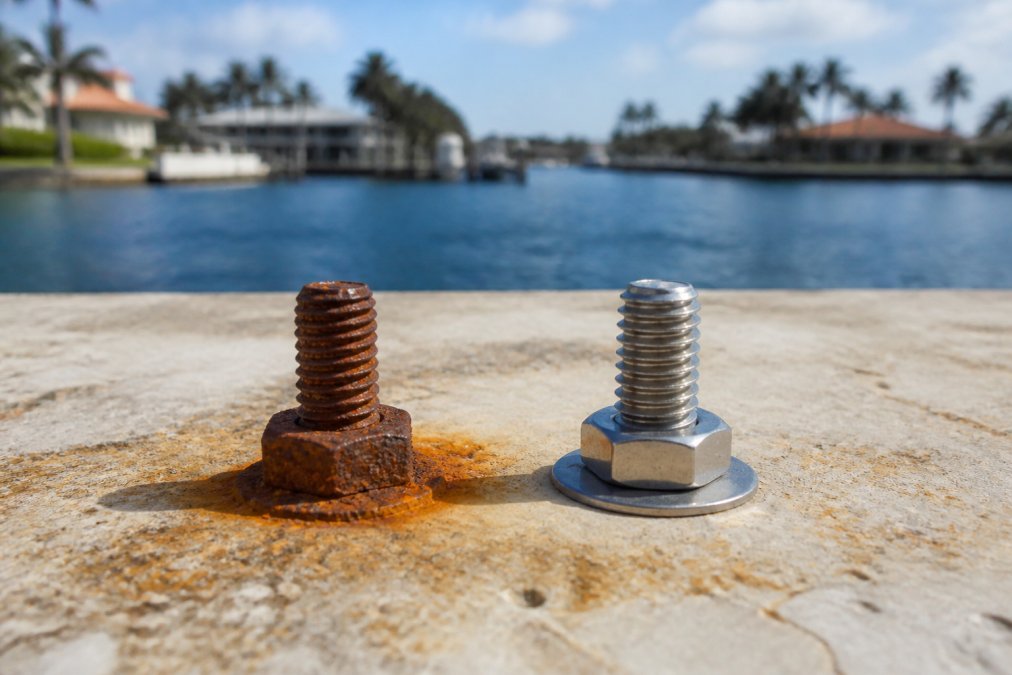
Standard steel hardware corrodes within months in Broward's salt air. Stainless steel resists corrosion through a self-healing oxide layer, but 304-grade (common in appliances) can pit in high-chloride environments. 316-grade stainless, with added molybdenum, is designed for coastal use and significantly outperforms 304. For outdoor bars in Broward, specify 316-grade stainless steel for all hardware, fasteners, appliances, and structural components.
Countertop Materials and Coastal Durability
Granite is non-porous when sealed and resists staining but requires resealing every 1-2 years and can etch from acidic substances. Expect 15-20 years with proper maintenance. Engineered stone (quartz) is non-porous, doesn't require sealing, and resists etching better than granite. Expected lifespan: 20+ years with minimal degradation. Concrete is porous, absorbs salt-laden moisture, stains easily, and cracks from thermal cycling, not recommended for Broward County outdoor bars.
Cabinet and Structural Materials
Pressure-treated pine absorbs moisture and corrodes within 5-7 years. Teak naturally resists rot and lasts 15-20+ years with occasional oiling. Ipe is denser and exceeds 20 years. Composite materials eliminate wood rot, resist salt spray, and last 20-30 years with minimal maintenance, the lowest-maintenance option for Broward County. Marine-grade plywood outperforms standard plywood and lasts 10-15 years with proper sealing.
Tile, Stone Veneer, and Finishes
Porcelain tile absorbs less than 0.5% moisture, resists salt spray, and lasts 20+ years. Natural stone veneer requires sealing and professional installation; choose denser stones like slate and reseal every 2-3 years. Lifespan: 15-20 years with proper care.
Fasteners and Hardware
Standard steel fasteners corrode within months in salt air, causing structural loosening and rust staining. Always specify 316-grade stainless steel bolts, screws, fasteners, hinges, and latches. Avoid mixing metals, which accelerates galvanic corrosion.
Protective Coatings and Maintenance
Teak and ipe benefit from annual or biennial oiling. Stainless steel should be cleaned regularly to prevent salt-initiated pitting. Granite and porous stone require resealing every 1-2 years. Engineered stone and porcelain tile don't require sealing but benefit from periodic deep cleaning.
Material Longevity Summary
In Broward County's coastal environment, expect these lifespans with proper maintenance:
- Engineered stone countertops: 20+ years
- Porcelain tile: 20+ years
- Stainless steel (316-grade) appliances and hardware: 20+ years
- Composite cabinetry: 20-30 years
- Teak or ipe wood: 15-20+ years
- Granite with regular resealing: 15-20 years
- Pressure-treated wood: 5-7 years (not recommended)
- Concrete: 8-12 years (high maintenance)
The upfront cost difference between coastal-rated materials and standard alternatives is typically 15-25%, but the durability difference is 2-3x. Investing in proper materials now prevents expensive replacement or repair in 5-10 years.
Outdoor Bar Permit Requirements
Building permits are required in Broward County and ensure code compliance. Skipping permits creates liability and resale problems. Broward County's specific code requirements differ from other Florida jurisdictions, so understanding local rules upfront prevents costly design revisions.
Broward County Building Code Specifics
Broward County adopts the Florida Building Code with local amendments. Key thresholds: structures under 200 square feet may qualify for simplified permits; setback requirements are 5 feet from side lines and 25 feet from front (verify your zone); height limits are 15 feet (up to 20 with variance). Electrical service requires a licensed electrician and GFCI protection within 6 feet of water sources. Plumbing requires separate permits. Bars taller than 6 feet or with roof loads require stamped engineering drawings; Broward County's 150 mph Design Wind Speed requires roof structures engineered for hurricane-force winds.
The Broward County Permit Timeline
Most permits take 2-4 weeks for initial review with complete submissions. Common rejection reasons: missing property survey, incomplete electrical plans, structural plans lacking wind-load calculations, and plumbing designs without proper slope. Once approved, inspections occur at framing, electrical rough-in, plumbing rough-in, and final completion. Each must pass before proceeding.
HOA and Deed Restrictions
Many Broward County neighborhoods have HOAs or deed restrictions beyond county code. Some require architectural approval, others limit bar size or materials. Check your HOA documents before design begins to avoid costly redesigns.
Why Professional Contractors Accelerate Permitting
Licensed Broward County contractors know local inspectors, which details trigger revision requests, and which design choices commonly fail inspection. They design roof structures to pass engineering review on the first submission rather than requiring revision.
Permit Costs
Broward County permit fees are based on project valuation. A typical custom outdoor bar with electrical and plumbing might carry a permit fee of $300-$800 depending on the estimated construction cost. Engineering review fees (if required) add $200-$500. Plan review fees are included in the permit cost. These are legitimate expenses that protect your investment and property value.
Outdoor Kitchen Island Cost and Design Options
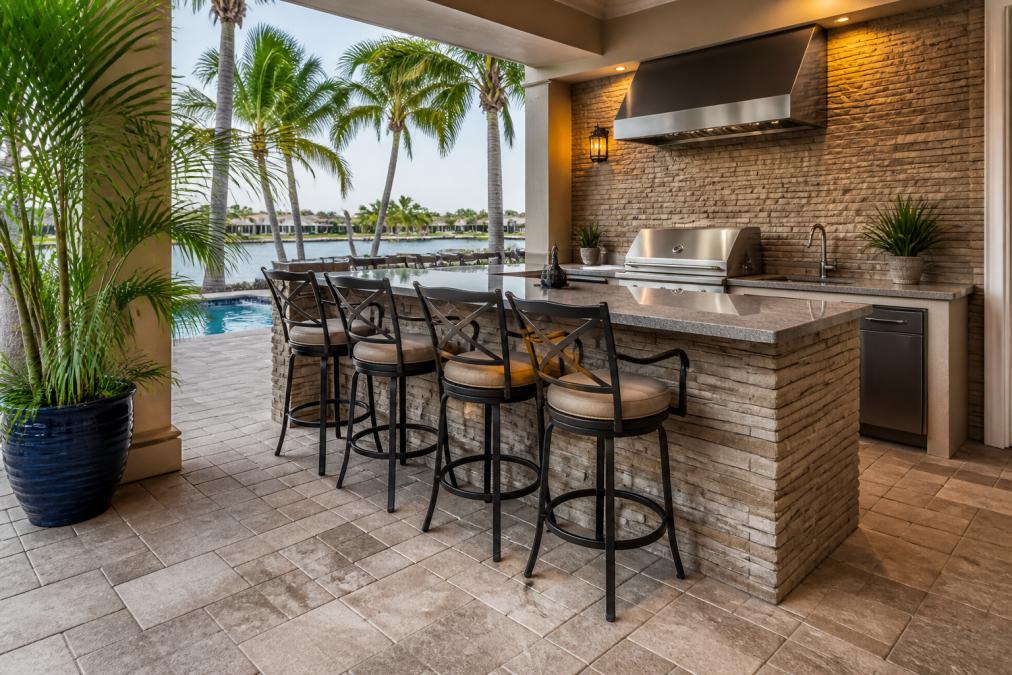
Outdoor kitchen islands integrate cooking, prep, and serving functions. Basic islands with cooktop and counter space cost less than premium versions with grills, side burners, refrigeration, and sinks. L-shaped islands maximize counter space; linear islands work for narrower spaces. A 6-foot island suits small gatherings; 10-12 feet accommodates larger crowds. High-end grills with infrared burners cost more but offer better performance. Stainless steel withstands Broward's coastal environment. Include at least 18 inches of prep space on either side of the grill, a dedicated sink with hot water, and proper ventilation above cooking surfaces.
| Feature | Impact on Cost | Durability in Coastal Climate | Best For |
|---|---|---|---|
| Basic cooktop only | Lower | Good with sealing | Budget-conscious entertaining |
| Built-in grill + side burners | Moderate | Excellent (stainless steel) | Regular hosting, serious cooks |
| Grill + refrigeration + sink | Higher | Excellent | Full outdoor kitchen experience |
| Premium appliances + warming drawer | Highest | Excellent | Luxury entertaining spaces |
Professional Installation vs. DIY Approach
The choice between hiring professionals and building yourself determines project timeline, quality, and risk exposure.
DIY construction appeals to budget-conscious homeowners and those with construction experience. You control timing and can work at your own pace. Material costs stay lower without contractor markup. However, DIY introduces significant risks: permit violations, improper installation of electrical or plumbing systems, structural failures, and warranty voids on appliances installed by non-professionals.
Professional installation ensures code compliance and proper execution. Contractors carry liability insurance protecting you if something goes wrong. They navigate permitting efficiently, saving weeks of bureaucratic back-and-forth. Appliance manufacturers often require professional installation to honor warranties. In Broward County's complex building environment, professional expertise typically pays for itself through faster permitting and fewer costly mistakes.
Labor costs vary based on project complexity. Simple bar installation might run 40-60 hours of labor. A full outdoor kitchen island with utilities integration could require 100+ hours. Broward County's labor rates reflect regional demand and contractor experience levels.
The real cost of DIY mistakes often exceeds contractor fees. Improper electrical installation creates fire hazards. Plumbing errors cause water damage. Structural problems develop years later. Professional contractors carry licenses, insurance, and accountability, protections DIY builders lack.
ROI and Property Value Impact
A well-executed custom outdoor bar enhances both lifestyle and property value. Outdoor living spaces rank consistently among buyers' top renovation priorities, particularly in Florida's climate where year-round entertaining is possible.
Property value gains depend on execution quality and market positioning.
Getting Your Custom Outdoor Bar Quote
Requesting quotes from multiple contractors reveals market pricing and helps you understand what drives cost differences. A detailed quote should break down materials, labor, permits, and timeline separately so you see exactly where money goes.
Frequently Asked Questions
How much does it cost to build a custom outdoor bar in Broward County?
Custom outdoor bar costs vary significantly based on size, materials, and features. Factors like granite countertops, stainless steel components, electrical work, and plumbing integration all impact final pricing. Contact Dimensions Luxury Builders for a detailed quote tailored to your specific vision and property.
What weather-resistant materials are best for outdoor bars in this climate?
Granite and stone veneer offer excellent durability and resist moisture and UV damage. Stainless steel appliances and hardware withstand humidity and salt air exposure. Marine-grade sealants protect all joints and surfaces. In coastal areas, these materials prevent deterioration from humidity, salt spray, and intense sun exposure that would damage standard indoor materials.
Do I need a permit to build an outdoor bar in Broward County?
Yes, most permanent outdoor bar structures require permits from your local building department. Permits ensure the structure meets electrical, plumbing, and structural codes. The permitting process typically involves submitting detailed plans and passing inspections. Professional builders like Dimensions Luxury Builders handle the entire permitting process, which streamlines approval and prevents costly code violations or removal orders later.
What's included in a professional outdoor bar installation?
Full-service installation includes design consultation, material selection, construction, electrical and plumbing integration, countertop installation, appliance setup, and final inspection. Professional builders manage permits, coordinate inspections, and handle all labor. This end-to-end approach eliminates the need to hire multiple contractors and ensures your bar meets all local codes and safety standards.